
Get trending papers in your email inbox once a day!
Get trending papers in your email inbox!
Subscribe



Categorical Schrödinger Bridge Matching
The Schr\"odinger Bridge (SB) is a powerful framework for solving generative modeling tasks such as unpaired domain translation. Most SB-related research focuses on continuous data space R^{D} and leaves open theoretical and algorithmic questions about applying SB methods to discrete data, e.g, on finite spaces S^{D}. Notable examples of such sets S are codebooks of vector-quantized (VQ) representations of modern autoencoders, tokens in texts, categories of atoms in molecules, etc. In this paper, we provide a theoretical and algorithmic foundation for solving SB in discrete spaces using the recently introduced Iterative Markovian Fitting (IMF) procedure. Specifically, we theoretically justify the convergence of discrete-time IMF (D-IMF) to SB in discrete spaces. This enables us to develop a practical computational algorithm for SB which we call Categorical Schr\"odinger Bridge Matching (CSBM). We show the performance of CSBM via a series of experiments with synthetic data and VQ representations of images.

Continuous Diffusion Model for Language Modeling
Diffusion models have emerged as a promising alternative to autoregressive models in modeling discrete categorical data. Yet diffusion models that directly work on discrete data space do not fully exploit the power of iterative refinement, as the signals are lost during the transition between discrete states. Existing continuous diffusion models for discrete data have limited performance compared to discrete approaches, and the unclear link between them restricts the development of diffusion models for discrete data. In this work, we propose a continuous diffusion model for language modeling that incorporates the geometry of the underlying categorical distribution. We establish a connection between the discrete diffusion and continuous flow on the statistical manifold, and building on the analogy, we introduce a simple design for the diffusion process that generalizes previous discrete diffusion models. We further propose a simulation-free training framework based on radial symmetry and a simple technique to address the high dimensionality of the manifold. Comprehensive experiments on language modeling benchmarks and other modalities show that our method outperforms existing discrete diffusion models and approaches the performance of autoregressive models. Codes available at https://github.com/harryjo97/RDLM{https://github.com/harryjo97/RDLM}.

Continuous-Time Functional Diffusion Processes
We introduce Functional Diffusion Processes (FDPs), which generalize score-based diffusion models to infinite-dimensional function spaces. FDPs require a new mathematical framework to describe the forward and backward dynamics, and several extensions to derive practical training objectives. These include infinite-dimensional versions of Girsanov theorem, in order to be able to compute an ELBO, and of the sampling theorem, in order to guarantee that functional evaluations in a countable set of points are equivalent to infinite-dimensional functions. We use FDPs to build a new breed of generative models in function spaces, which do not require specialized network architectures, and that can work with any kind of continuous data. Our results on real data show that FDPs achieve high-quality image generation, using a simple MLP architecture with orders of magnitude fewer parameters than existing diffusion models.



Functional Bayesian Tucker Decomposition for Continuous-indexed Tensor Data
Tucker decomposition is a powerful tensor model to handle multi-aspect data. It demonstrates the low-rank property by decomposing the grid-structured data as interactions between a core tensor and a set of object representations (factors). A fundamental assumption of such decomposition is that there are finite objects in each aspect or mode, corresponding to discrete indexes of data entries. However, real-world data is often not naturally posed in this setting. For example, geographic data is represented as continuous indexes of latitude and longitude coordinates, and cannot fit tensor models directly. To generalize Tucker decomposition to such scenarios, we propose Functional Bayesian Tucker Decomposition (FunBaT). We treat the continuous-indexed data as the interaction between the Tucker core and a group of latent functions. We use Gaussian processes (GP) as functional priors to model the latent functions. Then, we convert each GP into a state-space prior by constructing an equivalent stochastic differential equation (SDE) to reduce computational cost. An efficient inference algorithm is developed for scalable posterior approximation based on advanced message-passing techniques. The advantage of our method is shown in both synthetic data and several real-world applications. We release the code of FunBaT at https://github.com/xuangu-fang/Functional-Bayesian-Tucker-Decomposition.
TFG-Flow: Training-free Guidance in Multimodal Generative Flow
Given an unconditional generative model and a predictor for a target property (e.g., a classifier), the goal of training-free guidance is to generate samples with desirable target properties without additional training. As a highly efficient technique for steering generative models toward flexible outcomes, training-free guidance has gained increasing attention in diffusion models. However, existing methods only handle data in continuous spaces, while many scientific applications involve both continuous and discrete data (referred to as multimodality). Another emerging trend is the growing use of the simple and general flow matching framework in building generative foundation models, where guided generation remains under-explored. To address this, we introduce TFG-Flow, a novel training-free guidance method for multimodal generative flow. TFG-Flow addresses the curse-of-dimensionality while maintaining the property of unbiased sampling in guiding discrete variables. We validate TFG-Flow on four molecular design tasks and show that TFG-Flow has great potential in drug design by generating molecules with desired properties.

DialoGPS: Dialogue Path Sampling in Continuous Semantic Space for Data Augmentation in Multi-Turn Conversations
In open-domain dialogue generation tasks, contexts and responses in most datasets are one-to-one mapped, violating an important many-to-many characteristic: a context leads to various responses, and a response answers multiple contexts. Without such patterns, models poorly generalize and prefer responding safely. Many attempts have been made in either multi-turn settings from a one-to-many perspective or in a many-to-many perspective but limited to single-turn settings. The major challenge to many-to-many augment multi-turn dialogues is that discretely replacing each turn with semantic similarity breaks fragile context coherence. In this paper, we propose DialoGue Path Sampling (DialoGPS) method in continuous semantic space, the first many-to-many augmentation method for multi-turn dialogues. Specifically, we map a dialogue to our extended Brownian Bridge, a special Gaussian process. We sample latent variables to form coherent dialogue paths in the continuous space. A dialogue path corresponds to a new multi-turn dialogue and is used as augmented training data. We show the effect of DialoGPS with both automatic and human evaluation.
Modeling Temporal Data as Continuous Functions with Stochastic Process Diffusion
Temporal data such as time series can be viewed as discretized measurements of the underlying function. To build a generative model for such data we have to model the stochastic process that governs it. We propose a solution by defining the denoising diffusion model in the function space which also allows us to naturally handle irregularly-sampled observations. The forward process gradually adds noise to functions, preserving their continuity, while the learned reverse process removes the noise and returns functions as new samples. To this end, we define suitable noise sources and introduce novel denoising and score-matching models. We show how our method can be used for multivariate probabilistic forecasting and imputation, and how our model can be interpreted as a neural process.
Learning from Suboptimal Data in Continuous Control via Auto-Regressive Soft Q-Network
Reinforcement learning (RL) for continuous control often requires large amounts of online interaction data. Value-based RL methods can mitigate this burden by offering relatively high sample efficiency. Some studies further enhance sample efficiency by incorporating offline demonstration data to "kick-start" training, achieving promising results in continuous control. However, they typically compute the Q-function independently for each action dimension, neglecting interdependencies and making it harder to identify optimal actions when learning from suboptimal data, such as non-expert demonstration and online-collected data during the training process. To address these issues, we propose Auto-Regressive Soft Q-learning (ARSQ), a value-based RL algorithm that models Q-values in a coarse-to-fine, auto-regressive manner. First, ARSQ decomposes the continuous action space into discrete spaces in a coarse-to-fine hierarchy, enhancing sample efficiency for fine-grained continuous control tasks. Next, it auto-regressively predicts dimensional action advantages within each decision step, enabling more effective decision-making in continuous control tasks. We evaluate ARSQ on two continuous control benchmarks, RLBench and D4RL, integrating demonstration data into online training. On D4RL, which includes non-expert demonstrations, ARSQ achieves an average 1.62times performance improvement over SOTA value-based baseline. On RLBench, which incorporates expert demonstrations, ARSQ surpasses various baselines, demonstrating its effectiveness in learning from suboptimal online-collected data. Project page is at https://sites.google.com/view/ar-soft-q


UrbanVideo-Bench: Benchmarking Vision-Language Models on Embodied Intelligence with Video Data in Urban Spaces
Large multimodal models exhibit remarkable intelligence, yet their embodied cognitive abilities during motion in open-ended urban 3D space remain to be explored. We introduce a benchmark to evaluate whether video-large language models (Video-LLMs) can naturally process continuous first-person visual observations like humans, enabling recall, perception, reasoning, and navigation. We have manually control drones to collect 3D embodied motion video data from real-world cities and simulated environments, resulting in 1.5k video clips. Then we design a pipeline to generate 5.2k multiple-choice questions. Evaluations of 17 widely-used Video-LLMs reveal current limitations in urban embodied cognition. Correlation analysis provides insight into the relationships between different tasks, showing that causal reasoning has a strong correlation with recall, perception, and navigation, while the abilities for counterfactual and associative reasoning exhibit lower correlation with other tasks. We also validate the potential for Sim-to-Real transfer in urban embodiment through fine-tuning.

Space and Time Continuous Physics Simulation From Partial Observations
Modern techniques for physical simulations rely on numerical schemes and mesh-refinement methods to address trade-offs between precision and complexity, but these handcrafted solutions are tedious and require high computational power. Data-driven methods based on large-scale machine learning promise high adaptivity by integrating long-range dependencies more directly and efficiently. In this work, we focus on fluid dynamics and address the shortcomings of a large part of the literature, which are based on fixed support for computations and predictions in the form of regular or irregular grids. We propose a novel setup to perform predictions in a continuous spatial and temporal domain while being trained on sparse observations. We formulate the task as a double observation problem and propose a solution with two interlinked dynamical systems defined on, respectively, the sparse positions and the continuous domain, which allows to forecast and interpolate a solution from the initial condition. Our practical implementation involves recurrent GNNs and a spatio-temporal attention observer capable of interpolating the solution at arbitrary locations. Our model not only generalizes to new initial conditions (as standard auto-regressive models do) but also performs evaluation at arbitrary space and time locations. We evaluate on three standard datasets in fluid dynamics and compare to strong baselines, which are outperformed both in classical settings and in the extended new task requiring continuous predictions.
Hierarchical State Space Models for Continuous Sequence-to-Sequence Modeling
Reasoning from sequences of raw sensory data is a ubiquitous problem across fields ranging from medical devices to robotics. These problems often involve using long sequences of raw sensor data (e.g. magnetometers, piezoresistors) to predict sequences of desirable physical quantities (e.g. force, inertial measurements). While classical approaches are powerful for locally-linear prediction problems, they often fall short when using real-world sensors. These sensors are typically non-linear, are affected by extraneous variables (e.g. vibration), and exhibit data-dependent drift. For many problems, the prediction task is exacerbated by small labeled datasets since obtaining ground-truth labels requires expensive equipment. In this work, we present Hierarchical State-Space Models (HiSS), a conceptually simple, new technique for continuous sequential prediction. HiSS stacks structured state-space models on top of each other to create a temporal hierarchy. Across six real-world sensor datasets, from tactile-based state prediction to accelerometer-based inertial measurement, HiSS outperforms state-of-the-art sequence models such as causal Transformers, LSTMs, S4, and Mamba by at least 23% on MSE. Our experiments further indicate that HiSS demonstrates efficient scaling to smaller datasets and is compatible with existing data-filtering techniques. Code, datasets and videos can be found on https://hiss-csp.github.io.



Neural Continuous-Discrete State Space Models for Irregularly-Sampled Time Series
Learning accurate predictive models of real-world dynamic phenomena (e.g., climate, biological) remains a challenging task. One key issue is that the data generated by both natural and artificial processes often comprise time series that are irregularly sampled and/or contain missing observations. In this work, we propose the Neural Continuous-Discrete State Space Model (NCDSSM) for continuous-time modeling of time series through discrete-time observations. NCDSSM employs auxiliary variables to disentangle recognition from dynamics, thus requiring amortized inference only for the auxiliary variables. Leveraging techniques from continuous-discrete filtering theory, we demonstrate how to perform accurate Bayesian inference for the dynamic states. We propose three flexible parameterizations of the latent dynamics and an efficient training objective that marginalizes the dynamic states during inference. Empirical results on multiple benchmark datasets across various domains show improved imputation and forecasting performance of NCDSSM over existing models.

HR-INR: Continuous Space-Time Video Super-Resolution via Event Camera
Continuous space-time video super-resolution (C-STVSR) aims to simultaneously enhance video resolution and frame rate at an arbitrary scale. Recently, implicit neural representation (INR) has been applied to video restoration, representing videos as implicit fields that can be decoded at an arbitrary scale. However, the highly ill-posed nature of C-STVSR limits the effectiveness of current INR-based methods: they assume linear motion between frames and use interpolation or feature warping to generate features at arbitrary spatiotemporal positions with two consecutive frames. This restrains C-STVSR from capturing rapid and nonlinear motion and long-term dependencies (involving more than two frames) in complex dynamic scenes. In this paper, we propose a novel C-STVSR framework, called HR-INR, which captures both holistic dependencies and regional motions based on INR. It is assisted by an event camera, a novel sensor renowned for its high temporal resolution and low latency. To fully utilize the rich temporal information from events, we design a feature extraction consisting of (1) a regional event feature extractor - taking events as inputs via the proposed event temporal pyramid representation to capture the regional nonlinear motion and (2) a holistic event-frame feature extractor for long-term dependence and continuity motion. We then propose a novel INR-based decoder with spatiotemporal embeddings to capture long-term dependencies with a larger temporal perception field. We validate the effectiveness and generalization of our method on four datasets (both simulated and real data), showing the superiority of our method.

PonderLM-2: Pretraining LLM with Latent Thoughts in Continuous Space
The remarkable success of Chain-of-Thought (CoT), which enhances performance by scaling generation steps at test-time, inspires us to ask: can we leverage a similar scaling of computational steps during pretraining to improve the generation of each individual token? To address this, we propose a novel pre-training methodology: Pretraining Language Models with Latent Thoughts (PonderLM-2). Our approach pretrains a language model (LM) to first generate an intermediate latent thought-the last hidden state of the current position-which is then used as input to predict the actual subsequent token. This additional computational step enables the LM to refine its prediction within unconstrained continuous space. Our experiments demonstrate that, at an identical inference cost, a LM that generates one additional latent thought per token outperforms a standard model with double the parameters. For instance, our PonderLM-2-Pythia-1.4B, pretrained on 300B tokens from the Pile, significantly surpasses the vanilla Pythia-2.8B trained on the same data on both language modeling and a range of general downstream tasks. Furthermore, increasing the number of latent thoughts generated before each actual token-forming a chain analogous to CoT-consistently improves the model's performance.

Combining Recurrent, Convolutional, and Continuous-time Models with Linear State-Space Layers
Recurrent neural networks (RNNs), temporal convolutions, and neural differential equations (NDEs) are popular families of deep learning models for time-series data, each with unique strengths and tradeoffs in modeling power and computational efficiency. We introduce a simple sequence model inspired by control systems that generalizes these approaches while addressing their shortcomings. The Linear State-Space Layer (LSSL) maps a sequence u mapsto y by simply simulating a linear continuous-time state-space representation x = Ax + Bu, y = Cx + Du. Theoretically, we show that LSSL models are closely related to the three aforementioned families of models and inherit their strengths. For example, they generalize convolutions to continuous-time, explain common RNN heuristics, and share features of NDEs such as time-scale adaptation. We then incorporate and generalize recent theory on continuous-time memorization to introduce a trainable subset of structured matrices A that endow LSSLs with long-range memory. Empirically, stacking LSSL layers into a simple deep neural network obtains state-of-the-art results across time series benchmarks for long dependencies in sequential image classification, real-world healthcare regression tasks, and speech. On a difficult speech classification task with length-16000 sequences, LSSL outperforms prior approaches by 24 accuracy points, and even outperforms baselines that use hand-crafted features on 100x shorter sequences.
Vector-ICL: In-context Learning with Continuous Vector Representations
Large language models (LLMs) have shown remarkable in-context learning (ICL) capabilities on textual data. We explore whether these capabilities can be extended to continuous vectors from diverse domains, obtained from black-box pretrained encoders. By aligning input data with an LLM's embedding space through lightweight projectors, we observe that LLMs can effectively process and learn from these projected vectors, which we term Vector-ICL. In particular, we find that pretraining projectors with general language modeling objectives enables Vector-ICL, while task-specific finetuning further enhances performance. In our experiments across various tasks and modalities, including text reconstruction, numerical function regression, text classification, summarization, molecule captioning, time-series classification, graph classification, and fMRI decoding, Vector-ICL often surpasses both few-shot ICL and domain-specific model or tuning. We further conduct analyses and case studies, indicating the potential of LLMs to process vector representations beyond traditional token-based paradigms.


Neural FIM for learning Fisher Information Metrics from point cloud data
Although data diffusion embeddings are ubiquitous in unsupervised learning and have proven to be a viable technique for uncovering the underlying intrinsic geometry of data, diffusion embeddings are inherently limited due to their discrete nature. To this end, we propose neural FIM, a method for computing the Fisher information metric (FIM) from point cloud data - allowing for a continuous manifold model for the data. Neural FIM creates an extensible metric space from discrete point cloud data such that information from the metric can inform us of manifold characteristics such as volume and geodesics. We demonstrate Neural FIM's utility in selecting parameters for the PHATE visualization method as well as its ability to obtain information pertaining to local volume illuminating branching points and cluster centers embeddings of a toy dataset and two single-cell datasets of IPSC reprogramming and PBMCs (immune cells).
Continuous Visual Autoregressive Generation via Score Maximization
Conventional wisdom suggests that autoregressive models are used to process discrete data. When applied to continuous modalities such as visual data, Visual AutoRegressive modeling (VAR) typically resorts to quantization-based approaches to cast the data into a discrete space, which can introduce significant information loss. To tackle this issue, we introduce a Continuous VAR framework that enables direct visual autoregressive generation without vector quantization. The underlying theoretical foundation is strictly proper scoring rules, which provide powerful statistical tools capable of evaluating how well a generative model approximates the true distribution. Within this framework, all we need is to select a strictly proper score and set it as the training objective to optimize. We primarily explore a class of training objectives based on the energy score, which is likelihood-free and thus overcomes the difficulty of making probabilistic predictions in the continuous space. Previous efforts on continuous autoregressive generation, such as GIVT and diffusion loss, can also be derived from our framework using other strictly proper scores. Source code: https://github.com/shaochenze/EAR.

Deep Latent State Space Models for Time-Series Generation
Methods based on ordinary differential equations (ODEs) are widely used to build generative models of time-series. In addition to high computational overhead due to explicitly computing hidden states recurrence, existing ODE-based models fall short in learning sequence data with sharp transitions - common in many real-world systems - due to numerical challenges during optimization. In this work, we propose LS4, a generative model for sequences with latent variables evolving according to a state space ODE to increase modeling capacity. Inspired by recent deep state space models (S4), we achieve speedups by leveraging a convolutional representation of LS4 which bypasses the explicit evaluation of hidden states. We show that LS4 significantly outperforms previous continuous-time generative models in terms of marginal distribution, classification, and prediction scores on real-world datasets in the Monash Forecasting Repository, and is capable of modeling highly stochastic data with sharp temporal transitions. LS4 sets state-of-the-art for continuous-time latent generative models, with significant improvement of mean squared error and tighter variational lower bounds on irregularly-sampled datasets, while also being x100 faster than other baselines on long sequences.


Balancing Beyond Discrete Categories: Continuous Demographic Labels for Fair Face Recognition
Bias has been a constant in face recognition models. Over the years, researchers have looked at it from both the model and the data point of view. However, their approach to mitigation of data bias was limited and lacked insight on the real nature of the problem. Here, in this document, we propose to revise our use of ethnicity labels as a continuous variable instead of a discrete value per identity. We validate our formulation both experimentally and theoretically, showcasing that not all identities from one ethnicity contribute equally to the balance of the dataset; thus, having the same number of identities per ethnicity does not represent a balanced dataset. We further show that models trained on datasets balanced in the continuous space consistently outperform models trained on data balanced in the discrete space. We trained more than 65 different models, and created more than 20 subsets of the original datasets.

Efficient Estimation of Word Representations in Vector Space
We propose two novel model architectures for computing continuous vector representations of words from very large data sets. The quality of these representations is measured in a word similarity task, and the results are compared to the previously best performing techniques based on different types of neural networks. We observe large improvements in accuracy at much lower computational cost, i.e. it takes less than a day to learn high quality word vectors from a 1.6 billion words data set. Furthermore, we show that these vectors provide state-of-the-art performance on our test set for measuring syntactic and semantic word similarities.
Continuous Risk Factor Models: Analyzing Asset Correlations through Energy Distance
This paper introduces a novel approach to financial risk analysis that does not rely on traditional price and market data, instead using market news to model assets as distributions over a metric space of risk factors. By representing asset returns as integrals over the scalar field of these risk factors, we derive the covariance structure between asset returns. Utilizing encoder-only language models to embed this news data, we explore the relationships between asset return distributions through the concept of Energy Distance, establishing connections between distributional differences and excess returns co-movements. This data-agnostic approach provides new insights into portfolio diversification, risk management, and the construction of hedging strategies. Our findings have significant implications for both theoretical finance and practical risk management, offering a more robust framework for modelling complex financial systems without depending on conventional market data.

Mixture of experts models for multilevel data: modelling framework and approximation theory
Multilevel data are prevalent in many real-world applications. However, it remains an open research problem to identify and justify a class of models that flexibly capture a wide range of multilevel data. Motivated by the versatility of the mixture of experts (MoE) models in fitting regression data, in this article we extend upon the MoE and study a class of mixed MoE (MMoE) models for multilevel data. Under some regularity conditions, we prove that the MMoE is dense in the space of any continuous mixed effects models in the sense of weak convergence. As a result, the MMoE has a potential to accurately resemble almost all characteristics inherited in multilevel data, including the marginal distributions, dependence structures, regression links, random intercepts and random slopes. In a particular case where the multilevel data is hierarchical, we further show that a nested version of the MMoE universally approximates a broad range of dependence structures of the random effects among different factor levels.
TD-MPC2: Scalable, Robust World Models for Continuous Control
TD-MPC is a model-based reinforcement learning (RL) algorithm that performs local trajectory optimization in the latent space of a learned implicit (decoder-free) world model. In this work, we present TD-MPC2: a series of improvements upon the TD-MPC algorithm. We demonstrate that TD-MPC2 improves significantly over baselines across 104 online RL tasks spanning 4 diverse task domains, achieving consistently strong results with a single set of hyperparameters. We further show that agent capabilities increase with model and data size, and successfully train a single 317M parameter agent to perform 80 tasks across multiple task domains, embodiments, and action spaces. We conclude with an account of lessons, opportunities, and risks associated with large TD-MPC2 agents. Explore videos, models, data, code, and more at https://nicklashansen.github.io/td-mpc2

OSS-Net: Memory Efficient High Resolution Semantic Segmentation of 3D Medical Data
Convolutional neural networks (CNNs) are the current state-of-the-art meta-algorithm for volumetric segmentation of medical data, for example, to localize COVID-19 infected tissue on computer tomography scans or the detection of tumour volumes in magnetic resonance imaging. A key limitation of 3D CNNs on voxelised data is that the memory consumption grows cubically with the training data resolution. Occupancy networks (O-Nets) are an alternative for which the data is represented continuously in a function space and 3D shapes are learned as a continuous decision boundary. While O-Nets are significantly more memory efficient than 3D CNNs, they are limited to simple shapes, are relatively slow at inference, and have not yet been adapted for 3D semantic segmentation of medical data. Here, we propose Occupancy Networks for Semantic Segmentation (OSS-Nets) to accurately and memory-efficiently segment 3D medical data. We build upon the original O-Net with modifications for increased expressiveness leading to improved segmentation performance comparable to 3D CNNs, as well as modifications for faster inference. We leverage local observations to represent complex shapes and prior encoder predictions to expedite inference. We showcase OSS-Net's performance on 3D brain tumour and liver segmentation against a function space baseline (O-Net), a performance baseline (3D residual U-Net), and an efficiency baseline (2D residual U-Net). OSS-Net yields segmentation results similar to the performance baseline and superior to the function space and efficiency baselines. In terms of memory efficiency, OSS-Net consumes comparable amounts of memory as the function space baseline, somewhat more memory than the efficiency baseline and significantly less than the performance baseline. As such, OSS-Net enables memory-efficient and accurate 3D semantic segmentation that can scale to high resolutions.

AriEL: volume coding for sentence generation
Mapping sequences of discrete data to a point in a continuous space makes it difficult to retrieve those sequences via random sampling. Mapping the input to a volume would make it easier to retrieve at test time, and that's the strategy followed by the family of approaches based on Variational Autoencoder. However the fact that they are at the same time optimizing for prediction and for smoothness of representation, forces them to trade-off between the two. We improve on the performance of some of the standard methods in deep learning to generate sentences by uniformly sampling a continuous space. We do it by proposing AriEL, that constructs volumes in a continuous space, without the need of encouraging the creation of volumes through the loss function. We first benchmark on a toy grammar, that allows to automatically evaluate the language learned and generated by the models. Then, we benchmark on a real dataset of human dialogues. Our results indicate that the random access to the stored information is dramatically improved, and our method AriEL is able to generate a wider variety of correct language by randomly sampling the latent space. VAE follows in performance for the toy dataset while, AE and Transformer follow for the real dataset. This partially supports to the hypothesis that encoding information into volumes instead of into points, can lead to improved retrieval of learned information with random sampling. This can lead to better generators and we also discuss potential disadvantages.
LexLIP: Lexicon-Bottlenecked Language-Image Pre-Training for Large-Scale Image-Text Retrieval
Image-text retrieval (ITR) is a task to retrieve the relevant images/texts, given the query from another modality. The conventional dense retrieval paradigm relies on encoding images and texts into dense representations using dual-stream encoders, however, it faces challenges with low retrieval speed in large-scale retrieval scenarios. In this work, we propose the lexicon-weighting paradigm, where sparse representations in vocabulary space are learned for images and texts to take advantage of the bag-of-words models and efficient inverted indexes, resulting in significantly reduced retrieval latency. A crucial gap arises from the continuous nature of image data, and the requirement for a sparse vocabulary space representation. To bridge this gap, we introduce a novel pre-training framework, Lexicon-Bottlenecked Language-Image Pre-Training (LexLIP), that learns importance-aware lexicon representations. This framework features lexicon-bottlenecked modules between the dual-stream encoders and weakened text decoders, allowing for constructing continuous bag-of-words bottlenecks to learn lexicon-importance distributions. Upon pre-training with same-scale data, our LexLIP achieves state-of-the-art performance on two benchmark ITR datasets, MSCOCO and Flickr30k. Furthermore, in large-scale retrieval scenarios, LexLIP outperforms CLIP with a 5.5 ~ 221.3X faster retrieval speed and 13.2 ~ 48.8X less index storage memory.

Modeling Emotional Trajectories in Written Stories Utilizing Transformers and Weakly-Supervised Learning
Telling stories is an integral part of human communication which can evoke emotions and influence the affective states of the audience. Automatically modeling emotional trajectories in stories has thus attracted considerable scholarly interest. However, as most existing works have been limited to unsupervised dictionary-based approaches, there is no benchmark for this task. We address this gap by introducing continuous valence and arousal labels for an existing dataset of children's stories originally annotated with discrete emotion categories. We collect additional annotations for this data and map the categorical labels to the continuous valence and arousal space. For predicting the thus obtained emotionality signals, we fine-tune a DeBERTa model and improve upon this baseline via a weakly supervised learning approach. The best configuration achieves a Concordance Correlation Coefficient (CCC) of .8221 for valence and .7125 for arousal on the test set, demonstrating the efficacy of our proposed approach. A detailed analysis shows the extent to which the results vary depending on factors such as the author, the individual story, or the section within the story. In addition, we uncover the weaknesses of our approach by investigating examples that prove to be difficult to predict.

Joint Generative Modeling of Scene Graphs and Images via Diffusion Models
In this paper, we present a novel generative task: joint scene graph - image generation. While previous works have explored image generation conditioned on scene graphs or layouts, our task is distinctive and important as it involves generating scene graphs themselves unconditionally from noise, enabling efficient and interpretable control for image generation. Our task is challenging, requiring the generation of plausible scene graphs with heterogeneous attributes for nodes (objects) and edges (relations among objects), including continuous object bounding boxes and discrete object and relation categories. We introduce a novel diffusion model, DiffuseSG, that jointly models the adjacency matrix along with heterogeneous node and edge attributes. We explore various types of encodings for the categorical data, relaxing it into a continuous space. With a graph transformer being the denoiser, DiffuseSG successively denoises the scene graph representation in a continuous space and discretizes the final representation to generate the clean scene graph. Additionally, we introduce an IoU regularization to enhance the empirical performance. Our model significantly outperforms existing methods in scene graph generation on the Visual Genome and COCO-Stuff datasets, both on standard and newly introduced metrics that better capture the problem complexity. Moreover, we demonstrate the additional benefits of our model in two downstream applications: 1) excelling in a series of scene graph completion tasks, and 2) improving scene graph detection models by using extra training samples generated from DiffuseSG.

Unsupervised Hashing with Similarity Distribution Calibration
Unsupervised hashing methods typically aim to preserve the similarity between data points in a feature space by mapping them to binary hash codes. However, these methods often overlook the fact that the similarity between data points in the continuous feature space may not be preserved in the discrete hash code space, due to the limited similarity range of hash codes. The similarity range is bounded by the code length and can lead to a problem known as similarity collapse. That is, the positive and negative pairs of data points become less distinguishable from each other in the hash space. To alleviate this problem, in this paper a novel Similarity Distribution Calibration (SDC) method is introduced. SDC aligns the hash code similarity distribution towards a calibration distribution (e.g., beta distribution) with sufficient spread across the entire similarity range, thus alleviating the similarity collapse problem. Extensive experiments show that our SDC outperforms significantly the state-of-the-art alternatives on coarse category-level and instance-level image retrieval. Code is available at https://github.com/kamwoh/sdc.


Self-conditioned Embedding Diffusion for Text Generation
Can continuous diffusion models bring the same performance breakthrough on natural language they did for image generation? To circumvent the discrete nature of text data, we can simply project tokens in a continuous space of embeddings, as is standard in language modeling. We propose Self-conditioned Embedding Diffusion, a continuous diffusion mechanism that operates on token embeddings and allows to learn flexible and scalable diffusion models for both conditional and unconditional text generation. Through qualitative and quantitative evaluation, we show that our text diffusion models generate samples comparable with those produced by standard autoregressive language models - while being in theory more efficient on accelerator hardware at inference time. Our work paves the way for scaling up diffusion models for text, similarly to autoregressive models, and for improving performance with recent refinements to continuous diffusion.

FARMER: Flow AutoRegressive Transformer over Pixels
Directly modeling the explicit likelihood of the raw data distribution is key topic in the machine learning area, which achieves the scaling successes in Large Language Models by autoregressive modeling. However, continuous AR modeling over visual pixel data suffer from extremely long sequences and high-dimensional spaces. In this paper, we present FARMER, a novel end-to-end generative framework that unifies Normalizing Flows (NF) and Autoregressive (AR) models for tractable likelihood estimation and high-quality image synthesis directly from raw pixels. FARMER employs an invertible autoregressive flow to transform images into latent sequences, whose distribution is modeled implicitly by an autoregressive model. To address the redundancy and complexity in pixel-level modeling, we propose a self-supervised dimension reduction scheme that partitions NF latent channels into informative and redundant groups, enabling more effective and efficient AR modeling. Furthermore, we design a one-step distillation scheme to significantly accelerate inference speed and introduce a resampling-based classifier-free guidance algorithm to boost image generation quality. Extensive experiments demonstrate that FARMER achieves competitive performance compared to existing pixel-based generative models while providing exact likelihoods and scalable training.

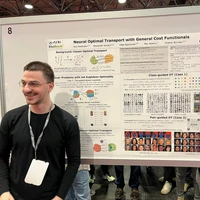
Neural Optimal Transport with General Cost Functionals
We introduce a novel neural network-based algorithm to compute optimal transport (OT) plans for general cost functionals. In contrast to common Euclidean costs, i.e., ell^1 or ell^2, such functionals provide more flexibility and allow using auxiliary information, such as class labels, to construct the required transport map. Existing methods for general costs are discrete and have limitations in practice, i.e. they do not provide an out-of-sample estimation. We address the challenge of designing a continuous OT approach for general costs that generalizes to new data points in high-dimensional spaces, such as images. Additionally, we provide the theoretical error analysis for our recovered transport plans. As an application, we construct a cost functional to map data distributions while preserving the class-wise structure.
Transition-Based Dependency Parsing with Stack Long Short-Term Memory
We propose a technique for learning representations of parser states in transition-based dependency parsers. Our primary innovation is a new control structure for sequence-to-sequence neural networks---the stack LSTM. Like the conventional stack data structures used in transition-based parsing, elements can be pushed to or popped from the top of the stack in constant time, but, in addition, an LSTM maintains a continuous space embedding of the stack contents. This lets us formulate an efficient parsing model that captures three facets of a parser's state: (i) unbounded look-ahead into the buffer of incoming words, (ii) the complete history of actions taken by the parser, and (iii) the complete contents of the stack of partially built tree fragments, including their internal structures. Standard backpropagation techniques are used for training and yield state-of-the-art parsing performance.
TOMATOES: Topology and Material Optimization for Latent Heat Thermal Energy Storage Devices
Latent heat thermal energy storage (LHTES) systems are compelling candidates for energy storage, primarily owing to their high storage density. Improving their performance is crucial for developing the next-generation efficient and cost effective devices. Topology optimization (TO) has emerged as a powerful computational tool to design LHTES systems by optimally distributing a high-conductivity material (HCM) and a phase change material (PCM). However, conventional TO typically limits to optimizing the geometry for a fixed, pre-selected materials. This approach does not leverage the large and expanding databases of novel materials. Consequently, the co-design of material and geometry for LHTES remains a challenge and unexplored. To address this limitation, we present an automated design framework for the concurrent optimization of material choice and topology. A key challenge is the discrete nature of material selection, which is incompatible with the gradient-based methods used for TO. We overcome this by using a data-driven variational autoencoder (VAE) to project discrete material databases for both the HCM and PCM onto continuous and differentiable latent spaces. These continuous material representations are integrated into an end-to-end differentiable, transient nonlinear finite-element solver that accounts for phase change. We demonstrate this framework on a problem aimed at maximizing the discharged energy within a specified time, subject to cost constraints. The effectiveness of the proposed method is validated through several illustrative examples.
Fast Reinforcement Learning with Incremental Gaussian Mixture Models
This work presents a novel algorithm that integrates a data-efficient function approximator with reinforcement learning in continuous state spaces. An online and incremental algorithm capable of learning from a single pass through data, called Incremental Gaussian Mixture Network (IGMN), was employed as a sample-efficient function approximator for the joint state and Q-values space, all in a single model, resulting in a concise and data-efficient algorithm, i.e., a reinforcement learning algorithm that learns from very few interactions with the environment. Results are analyzed to explain the properties of the obtained algorithm, and it is observed that the use of the IGMN function approximator brings some important advantages to reinforcement learning in relation to conventional neural networks trained by gradient descent methods.

DDMI: Domain-Agnostic Latent Diffusion Models for Synthesizing High-Quality Implicit Neural Representations
Recent studies have introduced a new class of generative models for synthesizing implicit neural representations (INRs) that capture arbitrary continuous signals in various domains. These models opened the door for domain-agnostic generative models, but they often fail to achieve high-quality generation. We observed that the existing methods generate the weights of neural networks to parameterize INRs and evaluate the network with fixed positional embeddings (PEs). Arguably, this architecture limits the expressive power of generative models and results in low-quality INR generation. To address this limitation, we propose Domain-agnostic Latent Diffusion Model for INRs (DDMI) that generates adaptive positional embeddings instead of neural networks' weights. Specifically, we develop a Discrete-to-continuous space Variational AutoEncoder (D2C-VAE), which seamlessly connects discrete data and the continuous signal functions in the shared latent space. Additionally, we introduce a novel conditioning mechanism for evaluating INRs with the hierarchically decomposed PEs to further enhance expressive power. Extensive experiments across four modalities, e.g., 2D images, 3D shapes, Neural Radiance Fields, and videos, with seven benchmark datasets, demonstrate the versatility of DDMI and its superior performance compared to the existing INR generative models.


LaVin-DiT: Large Vision Diffusion Transformer
This paper presents the Large Vision Diffusion Transformer (LaVin-DiT), a scalable and unified foundation model designed to tackle over 20 computer vision tasks in a generative framework. Unlike existing large vision models directly adapted from natural language processing architectures, which rely on less efficient autoregressive techniques and disrupt spatial relationships essential for vision data, LaVin-DiT introduces key innovations to optimize generative performance for vision tasks. First, to address the high dimensionality of visual data, we incorporate a spatial-temporal variational autoencoder that encodes data into a continuous latent space. Second, for generative modeling, we develop a joint diffusion transformer that progressively produces vision outputs. Third, for unified multi-task training, in-context learning is implemented. Input-target pairs serve as task context, which guides the diffusion transformer to align outputs with specific tasks within the latent space. During inference, a task-specific context set and test data as queries allow LaVin-DiT to generalize across tasks without fine-tuning. Trained on extensive vision datasets, the model is scaled from 0.1B to 3.4B parameters, demonstrating substantial scalability and state-of-the-art performance across diverse vision tasks. This work introduces a novel pathway for large vision foundation models, underscoring the promising potential of diffusion transformers. The code and models will be open-sourced.
Dita: Scaling Diffusion Transformer for Generalist Vision-Language-Action Policy
While recent vision-language-action models trained on diverse robot datasets exhibit promising generalization capabilities with limited in-domain data, their reliance on compact action heads to predict discretized or continuous actions constrains adaptability to heterogeneous action spaces. We present Dita, a scalable framework that leverages Transformer architectures to directly denoise continuous action sequences through a unified multimodal diffusion process. Departing from prior methods that condition denoising on fused embeddings via shallow networks, Dita employs in-context conditioning -- enabling fine-grained alignment between denoised actions and raw visual tokens from historical observations. This design explicitly models action deltas and environmental nuances. By scaling the diffusion action denoiser alongside the Transformer's scalability, Dita effectively integrates cross-embodiment datasets across diverse camera perspectives, observation scenes, tasks, and action spaces. Such synergy enhances robustness against various variances and facilitates the successful execution of long-horizon tasks. Evaluations across extensive benchmarks demonstrate state-of-the-art or comparative performance in simulation. Notably, Dita achieves robust real-world adaptation to environmental variances and complex long-horizon tasks through 10-shot finetuning, using only third-person camera inputs. The architecture establishes a versatile, lightweight and open-source baseline for generalist robot policy learning. Project Page: https://robodita.github.io.




Argmax Flows and Multinomial Diffusion: Learning Categorical Distributions
Generative flows and diffusion models have been predominantly trained on ordinal data, for example natural images. This paper introduces two extensions of flows and diffusion for categorical data such as language or image segmentation: Argmax Flows and Multinomial Diffusion. Argmax Flows are defined by a composition of a continuous distribution (such as a normalizing flow), and an argmax function. To optimize this model, we learn a probabilistic inverse for the argmax that lifts the categorical data to a continuous space. Multinomial Diffusion gradually adds categorical noise in a diffusion process, for which the generative denoising process is learned. We demonstrate that our method outperforms existing dequantization approaches on text modelling and modelling on image segmentation maps in log-likelihood.
Authentic Discrete Diffusion Model
We propose an Authentic Discrete Diffusion (ADD) framework that fundamentally redefines prior pseudo-discrete approaches by preserving core diffusion characteristics directly in the one-hot space through a suite of coordinated mechanisms. Unlike conventional "pseudo" discrete diffusion (PDD) methods, ADD reformulates the diffusion input by directly using float-encoded one-hot class data, without relying on diffusing in the continuous latent spaces or masking policies. At its core, a timestep-conditioned cross-entropy loss is introduced between the diffusion model's outputs and the original one-hot labels. This synergistic design establishes a bridge between discriminative and generative learning. Our experiments demonstrate that ADD not only achieves superior performance on classification tasks compared to the baseline, but also exhibits excellent text generation capabilities on Image captioning. Extensive ablations validate the measurable gains of each component.
Denoising with a Joint-Embedding Predictive Architecture
Joint-embedding predictive architectures (JEPAs) have shown substantial promise in self-supervised representation learning, yet their application in generative modeling remains underexplored. Conversely, diffusion models have demonstrated significant efficacy in modeling arbitrary probability distributions. In this paper, we introduce Denoising with a Joint-Embedding Predictive Architecture (D-JEPA), pioneering the integration of JEPA within generative modeling. By recognizing JEPA as a form of masked image modeling, we reinterpret it as a generalized next-token prediction strategy, facilitating data generation in an auto-regressive manner. Furthermore, we incorporate diffusion loss to model the per-token probability distribution, enabling data generation in a continuous space. We also adapt flow matching loss as an alternative to diffusion loss, thereby enhancing the flexibility of D-JEPA. Empirically, with increased GFLOPs, D-JEPA consistently achieves lower FID scores with fewer training epochs, indicating its good scalability. Our base, large, and huge models outperform all previous generative models across all scales on class-conditional ImageNet benchmarks. Beyond image generation, D-JEPA is well-suited for other continuous data modeling, including video and audio.

A Cheaper and Better Diffusion Language Model with Soft-Masked Noise
Diffusion models that are based on iterative denoising have been recently proposed and leveraged in various generation tasks like image generation. Whereas, as a way inherently built for continuous data, existing diffusion models still have some limitations in modeling discrete data, e.g., languages. For example, the generally used Gaussian noise can not handle the discrete corruption well, and the objectives in continuous spaces fail to be stable for textual data in the diffusion process especially when the dimension is high. To alleviate these issues, we introduce a novel diffusion model for language modeling, Masked-Diffuse LM, with lower training cost and better performances, inspired by linguistic features in languages. Specifically, we design a linguistic-informed forward process which adds corruptions to the text through strategically soft-masking to better noise the textual data. Also, we directly predict the categorical distribution with cross-entropy loss function in every diffusion step to connect the continuous space and discrete space in a more efficient and straightforward way. Through experiments on 5 controlled generation tasks, we demonstrate that our Masked-Diffuse LM can achieve better generation quality than the state-of-the-art diffusion models with better efficiency.
Instruction Induction: From Few Examples to Natural Language Task Descriptions
Large language models are able to perform a task by conditioning on a few input-output demonstrations - a paradigm known as in-context learning. We show that language models can explicitly infer an underlying task from a few demonstrations by prompting them to generate a natural language instruction that fits the examples. To explore this ability, we introduce the instruction induction challenge, compile a dataset consisting of 24 tasks, and define a novel evaluation metric based on executing the generated instruction. We discover that, to a large extent, the ability to generate instructions does indeed emerge when using a model that is both large enough and aligned to follow instructions; InstructGPT achieves 65.7% of human performance in our execution-based metric, while the original GPT-3 model reaches only 9.8% of human performance. This surprising result suggests that instruction induction might be a viable learning paradigm in and of itself, where instead of fitting a set of latent continuous parameters to the data, one searches for the best description in the natural language hypothesis space.

ReCogDrive: A Reinforced Cognitive Framework for End-to-End Autonomous Driving
Although end-to-end autonomous driving has made remarkable progress, its performance degrades significantly in rare and long-tail scenarios. Recent approaches attempt to address this challenge by leveraging the rich world knowledge of Vision-Language Models (VLMs), but these methods suffer from several limitations: (1) a significant domain gap between the pre-training data of VLMs and real-world driving data, (2) a dimensionality mismatch between the discrete language space and the continuous action space, and (3) imitation learning tends to capture the average behavior present in the dataset, which may be suboptimal even dangerous. In this paper, we propose ReCogDrive, an autonomous driving system that integrates VLMs with diffusion planner, which adopts a three-stage paradigm for training. In the first stage, we use a large-scale driving question-answering datasets to train the VLMs, mitigating the domain discrepancy between generic content and real-world driving scenarios. In the second stage, we employ a diffusion-based planner to perform imitation learning, mapping representations from the latent language space to continuous driving actions. Finally, we fine-tune the diffusion planner using reinforcement learning with NAVSIM non-reactive simulator, enabling the model to generate safer, more human-like driving trajectories. We evaluate our approach on the planning-oriented NAVSIM benchmark, achieving a PDMS of 89.6 and setting a new state-of-the-art that surpasses the previous vision-only SOTA by 5.6 PDMS.


End-to-End Retrieval in Continuous Space
Most text-based information retrieval (IR) systems index objects by words or phrases. These discrete systems have been augmented by models that use embeddings to measure similarity in continuous space. But continuous-space models are typically used just to re-rank the top candidates. We consider the problem of end-to-end continuous retrieval, where standard approximate nearest neighbor (ANN) search replaces the usual discrete inverted index, and rely entirely on distances between learned embeddings. By training simple models specifically for retrieval, with an appropriate model architecture, we improve on a discrete baseline by 8% and 26% (MAP) on two similar-question retrieval tasks. We also discuss the problem of evaluation for retrieval systems, and show how to modify existing pairwise similarity datasets for this purpose.
Online Continual Learning Without the Storage Constraint
Online continual learning (OCL) research has primarily focused on mitigating catastrophic forgetting with fixed and limited storage allocation throughout the agent's lifetime. However, the growing affordability of data storage highlights a broad range of applications that do not adhere to these assumptions. In these cases, the primary concern lies in managing computational expenditures rather than storage. In this paper, we target such settings, investigating the online continual learning problem by relaxing storage constraints and emphasizing fixed, limited economical budget. We provide a simple algorithm that can compactly store and utilize the entirety of the incoming data stream under tiny computational budgets using a kNN classifier and universal pre-trained feature extractors. Our algorithm provides a consistency property attractive to continual learning: It will never forget past seen data. We set a new state of the art on two large-scale OCL datasets: Continual LOCalization (CLOC), which has 39M images over 712 classes, and Continual Google Landmarks V2 (CGLM), which has 580K images over 10,788 classes -- beating methods under far higher computational budgets than ours in terms of both reducing catastrophic forgetting of past data and quickly adapting to rapidly changing data streams. We provide code to reproduce our results at https://github.com/drimpossible/ACM.


LEANN: A Low-Storage Vector Index
Embedding-based search is widely used in applications such as recommendation and retrieval-augmented generation (RAG). Recently, there is a growing demand to support these capabilities over personal data stored locally on devices. However, maintaining the necessary data structure associated with the embedding-based search is often infeasible due to its high storage overhead. For example, indexing 100 GB of raw data requires 150 to 700 GB of storage, making local deployment impractical. Reducing this overhead while maintaining search quality and latency becomes a critical challenge. In this paper, we present LEANN, a storage-efficient approximate nearest neighbor (ANN) search index optimized for resource-constrained personal devices. LEANN combines a compact graph-based structure with an efficient on-the-fly recomputation strategy to enable fast and accurate retrieval with minimal storage overhead. Our evaluation shows that LEANN reduces index size to under 5% of the original raw data, achieving up to 50 times smaller storage than standard indexes, while maintaining 90% top-3 recall in under 2 seconds on real-world question answering benchmarks.


CBOW Is Not All You Need: Combining CBOW with the Compositional Matrix Space Model
Continuous Bag of Words (CBOW) is a powerful text embedding method. Due to its strong capabilities to encode word content, CBOW embeddings perform well on a wide range of downstream tasks while being efficient to compute. However, CBOW is not capable of capturing the word order. The reason is that the computation of CBOW's word embeddings is commutative, i.e., embeddings of XYZ and ZYX are the same. In order to address this shortcoming, we propose a learning algorithm for the Continuous Matrix Space Model, which we call Continual Multiplication of Words (CMOW). Our algorithm is an adaptation of word2vec, so that it can be trained on large quantities of unlabeled text. We empirically show that CMOW better captures linguistic properties, but it is inferior to CBOW in memorizing word content. Motivated by these findings, we propose a hybrid model that combines the strengths of CBOW and CMOW. Our results show that the hybrid CBOW-CMOW-model retains CBOW's strong ability to memorize word content while at the same time substantially improving its ability to encode other linguistic information by 8%. As a result, the hybrid also performs better on 8 out of 11 supervised downstream tasks with an average improvement of 1.2%.

DataFinder: Scientific Dataset Recommendation from Natural Language Descriptions
Modern machine learning relies on datasets to develop and validate research ideas. Given the growth of publicly available data, finding the right dataset to use is increasingly difficult. Any research question imposes explicit and implicit constraints on how well a given dataset will enable researchers to answer this question, such as dataset size, modality, and domain. We operationalize the task of recommending datasets given a short natural language description of a research idea, to help people find relevant datasets for their needs. Dataset recommendation poses unique challenges as an information retrieval problem; datasets are hard to directly index for search and there are no corpora readily available for this task. To facilitate this task, we build the DataFinder Dataset which consists of a larger automatically-constructed training set (17.5K queries) and a smaller expert-annotated evaluation set (392 queries). Using this data, we compare various information retrieval algorithms on our test set and present a superior bi-encoder retriever for text-based dataset recommendation. This system, trained on the DataFinder Dataset, finds more relevant search results than existing third-party dataset search engines. To encourage progress on dataset recommendation, we release our dataset and models to the public.

A Topological Approach to Measuring Training Data Quality
Data quality is crucial for the successful training, generalization and performance of artificial intelligence models. Furthermore, it is known that the leading approaches in artificial intelligence are notoriously data-hungry. In this paper, we propose the use of small training datasets towards faster training. Specifically, we provide a novel topological method based on morphisms between persistence modules to measure the training data quality with respect to the complete dataset. This way, we can provide an explanation of why the chosen training dataset will lead to poor performance.
AdapterSwap: Continuous Training of LLMs with Data Removal and Access-Control Guarantees
Large language models (LLMs) are increasingly capable of completing knowledge intensive tasks by recalling information from a static pretraining corpus. Here we are concerned with LLMs in the context of evolving data requirements. For instance: batches of new data that are introduced periodically; subsets of data with user-based access controls; or requirements on dynamic removal of documents with guarantees that associated knowledge cannot be recalled. We wish to satisfy these requirements while at the same time ensuring a model does not forget old information when new data becomes available. To address these issues, we introduce AdapterSwap, a training and inference scheme that organizes knowledge from a data collection into a set of low-rank adapters, which are dynamically composed during inference. Our experiments demonstrate AdapterSwap's ability to support efficient continual learning, while also enabling organizations to have fine-grained control over data access and deletion.


Auto-scaling Continuous Memory for GUI Agent
We study how to endow GUI agents with scalable memory that help generalize across unfamiliar interfaces and long-horizon tasks. Prior GUI agents compress past trajectories into text tokens, which balloons context length and misses decisive visual cues (e.g., exact widget size and position). We propose a continuous memory that encodes each GUI trajectory into a fixed-length sequence of continuous embeddings using the VLM itself as an encoder; these embeddings are plugged directly into the backbone's input layer, sharply reducing context cost while preserving fine-grained visual information. As memory size and retrieval depth increase, performance improves monotonically, unlike text memories that degrade with long prompts. To grow memory at low cost, we introduce an auto-scaling data flywheel that (i) discovers new environments via search, (ii) synthesizes tasks with an open-source VLM, (iii) rolls out trajectories with the agent, and (iv) verifies success with the same VLM. Using this pipeline, we collect 100k+ trajectories for about \$4000 and fine-tune only the memory encoder (LoRA on a Q-Former, 1.2\% parameters) with 1,500 samples. On real-world GUI benchmarks, our memory-augmented agent consistently improves success rates under long horizons and distribution shifts. Notably, Qwen-2.5-VL-7B + continuous memory achieves performance comparable to state-of-the-art closed-source models (e.g., GPT-4o, Claude-4).
Trove: A Flexible Toolkit for Dense Retrieval
We introduce Trove, an easy-to-use open-source retrieval toolkit that simplifies research experiments without sacrificing flexibility or speed. For the first time, we introduce efficient data management features that load and process (filter, select, transform, and combine) retrieval datasets on the fly, with just a few lines of code. This gives users the flexibility to easily experiment with different dataset configurations without the need to compute and store multiple copies of large datasets. Trove is highly customizable: in addition to many built-in options, it allows users to freely modify existing components or replace them entirely with user-defined objects. It also provides a low-code and unified pipeline for evaluation and hard negative mining, which supports multi-node execution without any code changes. Trove's data management features reduce memory consumption by a factor of 2.6. Moreover, Trove's easy-to-use inference pipeline incurs no overhead, and inference times decrease linearly with the number of available nodes. Most importantly, we demonstrate how Trove simplifies retrieval experiments and allows for arbitrary customizations, thus facilitating exploratory research.

MIG: Automatic Data Selection for Instruction Tuning by Maximizing Information Gain in Semantic Space
Data quality and diversity are key to the construction of effective instruction-tuning datasets. % With the increasing availability of open-source instruction-tuning datasets, it is advantageous to automatically select high-quality and diverse subsets from a vast amount of data. % Existing methods typically prioritize instance quality and use heuristic rules to maintain diversity. % However, this absence of a comprehensive view of the entire collection often leads to suboptimal results. % Moreover, heuristic rules generally focus on distance or clustering within the embedding space, which fails to accurately capture the intent of complex instructions in the semantic space. % To bridge this gap, we propose a unified method for quantifying the information content of datasets. This method models the semantic space by constructing a label graph and quantifies diversity based on the distribution of information within the graph. % Based on such a measurement, we further introduce an efficient sampling method that selects data samples iteratively to Maximize the Information Gain (MIG) in semantic space. % Experiments on various datasets and base models demonstrate that MIG consistently outperforms state-of-the-art methods. % Notably, the model fine-tuned with 5\% Tulu3 data sampled by MIG achieves comparable performance to the official SFT model trained on the full dataset, with improvements of +5.73\% on AlpacaEval and +6.89\% on Wildbench.


Scaling Laws for Data Filtering -- Data Curation cannot be Compute Agnostic
Vision-language models (VLMs) are trained for thousands of GPU hours on carefully curated web datasets. In recent times, data curation has gained prominence with several works developing strategies to retain 'high-quality' subsets of 'raw' scraped data. For instance, the LAION public dataset retained only 10% of the total crawled data. However, these strategies are typically developed agnostic of the available compute for training. In this paper, we first demonstrate that making filtering decisions independent of training compute is often suboptimal: the limited high-quality data rapidly loses its utility when repeated, eventually requiring the inclusion of 'unseen' but 'lower-quality' data. To address this quality-quantity tradeoff (QQT), we introduce neural scaling laws that account for the non-homogeneous nature of web data, an angle ignored in existing literature. Our scaling laws (i) characterize the differing 'utility' of various quality subsets of web data; (ii) account for how utility diminishes for a data point at its 'nth' repetition; and (iii) formulate the mutual interaction of various data pools when combined, enabling the estimation of model performance on a combination of multiple data pools without ever jointly training on them. Our key message is that data curation cannot be agnostic of the total compute that a model will be trained for. Our scaling laws allow us to curate the best possible pool for achieving top performance on Datacomp at various compute budgets, carving out a pareto-frontier for data curation. Code is available at https://github.com/locuslab/scaling_laws_data_filtering.

Large-scale Pre-trained Models are Surprisingly Strong in Incremental Novel Class Discovery
Discovering novel concepts in unlabelled datasets and in a continuous manner is an important desideratum of lifelong learners. In the literature such problems have been partially addressed under very restricted settings, where novel classes are learned by jointly accessing a related labelled set (e.g., NCD) or by leveraging only a supervisedly pre-trained model (e.g., class-iNCD). In this work we challenge the status quo in class-iNCD and propose a learning paradigm where class discovery occurs continuously and truly unsupervisedly, without needing any related labelled set. In detail, we propose to exploit the richer priors from strong self-supervised pre-trained models (PTM). To this end, we propose simple baselines, composed of a frozen PTM backbone and a learnable linear classifier, that are not only simple to implement but also resilient under longer learning scenarios. We conduct extensive empirical evaluation on a multitude of benchmarks and show the effectiveness of our proposed baselines when compared with sophisticated state-of-the-art methods. The code is open source.

Unsupervised Learning under Latent Label Shift
What sorts of structure might enable a learner to discover classes from unlabeled data? Traditional approaches rely on feature-space similarity and heroic assumptions on the data. In this paper, we introduce unsupervised learning under Latent Label Shift (LLS), where we have access to unlabeled data from multiple domains such that the label marginals p_d(y) can shift across domains but the class conditionals p(x|y) do not. This work instantiates a new principle for identifying classes: elements that shift together group together. For finite input spaces, we establish an isomorphism between LLS and topic modeling: inputs correspond to words, domains to documents, and labels to topics. Addressing continuous data, we prove that when each label's support contains a separable region, analogous to an anchor word, oracle access to p(d|x) suffices to identify p_d(y) and p_d(y|x) up to permutation. Thus motivated, we introduce a practical algorithm that leverages domain-discriminative models as follows: (i) push examples through domain discriminator p(d|x); (ii) discretize the data by clustering examples in p(d|x) space; (iii) perform non-negative matrix factorization on the discrete data; (iv) combine the recovered p(y|d) with the discriminator outputs p(d|x) to compute p_d(y|x) ; forall d. With semi-synthetic experiments, we show that our algorithm can leverage domain information to improve upon competitive unsupervised classification methods. We reveal a failure mode of standard unsupervised classification methods when feature-space similarity does not indicate true groupings, and show empirically that our method better handles this case. Our results establish a deep connection between distribution shift and topic modeling, opening promising lines for future work.

Reliable Measures of Spread in High Dimensional Latent Spaces
Understanding geometric properties of natural language processing models' latent spaces allows the manipulation of these properties for improved performance on downstream tasks. One such property is the amount of data spread in a model's latent space, or how fully the available latent space is being used. In this work, we define data spread and demonstrate that the commonly used measures of data spread, Average Cosine Similarity and a partition function min/max ratio I(V), do not provide reliable metrics to compare the use of latent space across models. We propose and examine eight alternative measures of data spread, all but one of which improve over these current metrics when applied to seven synthetic data distributions. Of our proposed measures, we recommend one principal component-based measure and one entropy-based measure that provide reliable, relative measures of spread and can be used to compare models of different sizes and dimensionalities.


Relational Experience Replay: Continual Learning by Adaptively Tuning Task-wise Relationship
Continual learning is a promising machine learning paradigm to learn new tasks while retaining previously learned knowledge over streaming training data. Till now, rehearsal-based methods, keeping a small part of data from old tasks as a memory buffer, have shown good performance in mitigating catastrophic forgetting for previously learned knowledge. However, most of these methods typically treat each new task equally, which may not adequately consider the relationship or similarity between old and new tasks. Furthermore, these methods commonly neglect sample importance in the continual training process and result in sub-optimal performance on certain tasks. To address this challenging problem, we propose Relational Experience Replay (RER), a bi-level learning framework, to adaptively tune task-wise relationships and sample importance within each task to achieve a better `stability' and `plasticity' trade-off. As such, the proposed method is capable of accumulating new knowledge while consolidating previously learned old knowledge during continual learning. Extensive experiments conducted on three publicly available datasets (i.e., CIFAR-10, CIFAR-100, and Tiny ImageNet) show that the proposed method can consistently improve the performance of all baselines and surpass current state-of-the-art methods.
R2D2: Reducing Redundancy and Duplication in Data Lakes
Enterprise data lakes often suffer from substantial amounts of duplicate and redundant data, with data volumes ranging from terabytes to petabytes. This leads to both increased storage costs and unnecessarily high maintenance costs for these datasets. In this work, we focus on identifying and reducing redundancy in enterprise data lakes by addressing the problem of 'dataset containment'. To the best of our knowledge, this is one of the first works that addresses table-level containment at a large scale. We propose R2D2: a three-step hierarchical pipeline that efficiently identifies almost all instances of containment by progressively reducing the search space in the data lake. It first builds (i) a schema containment graph, followed by (ii) statistical min-max pruning, and finally, (iii) content level pruning. We further propose minimizing the total storage and access costs by optimally identifying redundant datasets that can be deleted (and reconstructed on demand) while respecting latency constraints. We implement our system on Azure Databricks clusters using Apache Spark for enterprise data stored in ADLS Gen2, and on AWS clusters for open-source data. In contrast to existing modified baselines that are inaccurate or take several days to run, our pipeline can process an enterprise customer data lake at the TB scale in approximately 5 hours with high accuracy. We present theoretical results as well as extensive empirical validation on both enterprise (scale of TBs) and open-source datasets (scale of MBs - GBs), which showcase the effectiveness of our pipeline.


A soft nearest-neighbor framework for continual semi-supervised learning
Despite significant advances, the performance of state-of-the-art continual learning approaches hinges on the unrealistic scenario of fully labeled data. In this paper, we tackle this challenge and propose an approach for continual semi-supervised learning--a setting where not all the data samples are labeled. A primary issue in this scenario is the model forgetting representations of unlabeled data and overfitting the labeled samples. We leverage the power of nearest-neighbor classifiers to nonlinearly partition the feature space and flexibly model the underlying data distribution thanks to its non-parametric nature. This enables the model to learn a strong representation for the current task, and distill relevant information from previous tasks. We perform a thorough experimental evaluation and show that our method outperforms all the existing approaches by large margins, setting a solid state of the art on the continual semi-supervised learning paradigm. For example, on CIFAR-100 we surpass several others even when using at least 30 times less supervision (0.8% vs. 25% of annotations). Finally, our method works well on both low and high resolution images and scales seamlessly to more complex datasets such as ImageNet-100. The code is publicly available on https://github.com/kangzhiq/NNCSL

Curator: Efficient Indexing for Multi-Tenant Vector Databases
Vector databases have emerged as key enablers for bridging intelligent applications with unstructured data, providing generic search and management support for embedding vectors extracted from the raw unstructured data. As multiple data users can share the same database infrastructure, multi-tenancy support for vector databases is increasingly desirable. This hinges on an efficient filtered search operation, i.e., only querying the vectors accessible to a particular tenant. Multi-tenancy in vector databases is currently achieved by building either a single, shared index among all tenants, or a per-tenant index. The former optimizes for memory efficiency at the expense of search performance, while the latter does the opposite. Instead, this paper presents Curator, an in-memory vector index design tailored for multi-tenant queries that simultaneously achieves the two conflicting goals, low memory overhead and high performance for queries, vector insertion, and deletion. Curator indexes each tenant's vectors with a tenant-specific clustering tree and encodes these trees compactly as sub-trees of a shared clustering tree. Each tenant's clustering tree adapts dynamically to its unique vector distribution, while maintaining a low per-tenant memory footprint. Our evaluation, based on two widely used data sets, confirms that Curator delivers search performance on par with per-tenant indexing, while maintaining memory consumption at the same level as metadata filtering on a single, shared index.
FAIR Jupyter: a knowledge graph approach to semantic sharing and granular exploration of a computational notebook reproducibility dataset
The way in which data are shared can affect their utility and reusability. Here, we demonstrate how data that we had previously shared in bulk can be mobilized further through a knowledge graph that allows for much more granular exploration and interrogation. The original dataset is about the computational reproducibility of GitHub-hosted Jupyter notebooks associated with biomedical publications. It contains rich metadata about the publications, associated GitHub repositories and Jupyter notebooks, and the notebooks' reproducibility. We took this dataset, converted it into semantic triples and loaded these into a triple store to create a knowledge graph, FAIR Jupyter, that we made accessible via a web service. This enables granular data exploration and analysis through queries that can be tailored to specific use cases. Such queries may provide details about any of the variables from the original dataset, highlight relationships between them or combine some of the graph's content with materials from corresponding external resources. We provide a collection of example queries addressing a range of use cases in research and education. We also outline how sets of such queries can be used to profile specific content types, either individually or by class. We conclude by discussing how such a semantically enhanced sharing of complex datasets can both enhance their FAIRness, i.e., their findability, accessibility, interoperability, and reusability, and help identify and communicate best practices, particularly with regards to data quality, standardization, automation and reproducibility.
HyperInterval: Hypernetwork approach to training weight interval regions in continual learning
Recently, a new Continual Learning (CL) paradigm was presented to control catastrophic forgetting, called Interval Continual Learning (InterContiNet), which relies on enforcing interval constraints on the neural network parameter space. Unfortunately, InterContiNet training is challenging due to the high dimensionality of the weight space, making intervals difficult to manage. To address this issue, we introduce HyperInterval, a technique that employs interval arithmetic within the embedding space and utilizes a hypernetwork to map these intervals to the target network parameter space. We train interval embeddings for consecutive tasks and train a hypernetwork to transform these embeddings into weights of the target network. An embedding for a given task is trained along with the hypernetwork, preserving the response of the target network for the previous task embeddings. Interval arithmetic works with a more manageable, lower-dimensional embedding space rather than directly preparing intervals in a high-dimensional weight space. Our model allows faster and more efficient training. Furthermore, HyperInterval maintains the guarantee of not forgetting. At the end of training, we can choose one universal embedding to produce a single network dedicated to all tasks. In such a framework, hypernetwork is used only for training and can be seen as a meta-trainer. HyperInterval obtains significantly better results than InterContiNet and gives SOTA results on several benchmarks.

Putting Data at the Centre of Offline Multi-Agent Reinforcement Learning
Offline multi-agent reinforcement learning (MARL) is an exciting direction of research that uses static datasets to find optimal control policies for multi-agent systems. Though the field is by definition data-driven, efforts have thus far neglected data in their drive to achieve state-of-the-art results. We first substantiate this claim by surveying the literature, showing how the majority of works generate their own datasets without consistent methodology and provide sparse information about the characteristics of these datasets. We then show why neglecting the nature of the data is problematic, through salient examples of how tightly algorithmic performance is coupled to the dataset used, necessitating a common foundation for experiments in the field. In response, we take a big step towards improving data usage and data awareness in offline MARL, with three key contributions: (1) a clear guideline for generating novel datasets; (2) a standardisation of over 80 existing datasets, hosted in a publicly available repository, using a consistent storage format and easy-to-use API; and (3) a suite of analysis tools that allow us to understand these datasets better, aiding further development.




Continual Learning of Large Language Models: A Comprehensive Survey
The recent success of large language models (LLMs) trained on static, pre-collected, general datasets has sparked numerous research directions and applications. One such direction addresses the non-trivial challenge of integrating pre-trained LLMs into dynamic data distributions, task structures, and user preferences. Pre-trained LLMs, when tailored for specific needs, often experience significant performance degradation in previous knowledge domains -- a phenomenon known as "catastrophic forgetting". While extensively studied in the continual learning (CL) community, it presents new manifestations in the realm of LLMs. In this survey, we provide a comprehensive overview of the current research progress on LLMs within the context of CL. This survey is structured into four main sections: we first describe an overview of continually learning LLMs, consisting of two directions of continuity: vertical continuity (or vertical continual learning), i.e., continual adaptation from general to specific capabilities, and horizontal continuity (or horizontal continual learning), i.e., continual adaptation across time and domains (Section 3). We then summarize three stages of learning LLMs in the context of modern CL: Continual Pre-Training (CPT), Domain-Adaptive Pre-training (DAP), and Continual Fine-Tuning (CFT) (Section 4). Then we provide an overview of evaluation protocols for continual learning with LLMs, along with the current available data sources (Section 5). Finally, we discuss intriguing questions pertaining to continual learning for LLMs (Section 6). The full list of papers examined in this survey is available at https://github.com/Wang-ML-Lab/llm-continual-learning-survey.

Data Engineering for Scaling Language Models to 128K Context
We study the continual pretraining recipe for scaling language models' context lengths to 128K, with a focus on data engineering. We hypothesize that long context modeling, in particular the ability to utilize information at arbitrary input locations, is a capability that is mostly already acquired through large-scale pretraining, and that this capability can be readily extended to contexts substantially longer than seen during training~(e.g., 4K to 128K) through lightweight continual pretraining on appropriate data mixture. We investigate the quantity and quality of the data for continual pretraining: (1) for quantity, we show that 500 million to 5 billion tokens are enough to enable the model to retrieve information anywhere within the 128K context; (2) for quality, our results equally emphasize domain balance and length upsampling. Concretely, we find that naively upsampling longer data on certain domains like books, a common practice of existing work, gives suboptimal performance, and that a balanced domain mixture is important. We demonstrate that continual pretraining of the full model on 1B-5B tokens of such data is an effective and affordable strategy for scaling the context length of language models to 128K. Our recipe outperforms strong open-source long-context models and closes the gap to frontier models like GPT-4 128K.





SeiT: Storage-Efficient Vision Training with Tokens Using 1% of Pixel Storage
We need billion-scale images to achieve more generalizable and ground-breaking vision models, as well as massive dataset storage to ship the images (e.g., the LAION-4B dataset needs 240TB storage space). However, it has become challenging to deal with unlimited dataset storage with limited storage infrastructure. A number of storage-efficient training methods have been proposed to tackle the problem, but they are rarely scalable or suffer from severe damage to performance. In this paper, we propose a storage-efficient training strategy for vision classifiers for large-scale datasets (e.g., ImageNet) that only uses 1024 tokens per instance without using the raw level pixels; our token storage only needs <1% of the original JPEG-compressed raw pixels. We also propose token augmentations and a Stem-adaptor module to make our approach able to use the same architecture as pixel-based approaches with only minimal modifications on the stem layer and the carefully tuned optimization settings. Our experimental results on ImageNet-1k show that our method significantly outperforms other storage-efficient training methods with a large gap. We further show the effectiveness of our method in other practical scenarios, storage-efficient pre-training, and continual learning. Code is available at https://github.com/naver-ai/seit




Ad-datasets: a meta-collection of data sets for autonomous driving
Autonomous driving is among the largest domains in which deep learning has been fundamental for progress within the last years. The rise of datasets went hand in hand with this development. All the more striking is the fact that researchers do not have a tool available that provides a quick, comprehensive and up-to-date overview of data sets and their features in the domain of autonomous driving. In this paper, we present ad-datasets, an online tool that provides such an overview for more than 150 data sets. The tool enables users to sort and filter the data sets according to currently 16 different categories. ad-datasets is an open-source project with community contributions. It is in constant development, ensuring that the content stays up-to-date.

Continual Learning in Neural Networks
Artificial neural networks have exceeded human-level performance in accomplishing several individual tasks (e.g. voice recognition, object recognition, and video games). However, such success remains modest compared to human intelligence that can learn and perform an unlimited number of tasks. Humans' ability of learning and accumulating knowledge over their lifetime is an essential aspect of their intelligence. Continual machine learning aims at a higher level of machine intelligence through providing the artificial agents with the ability to learn online from a non-stationary and never-ending stream of data. A key component of such a never-ending learning process is to overcome the catastrophic forgetting of previously seen data, a problem that neural networks are well known to suffer from. The work described in this thesis has been dedicated to the investigation of continual learning and solutions to mitigate the forgetting phenomena in neural networks. To approach the continual learning problem, we first assume a task incremental setting where tasks are received one at a time and data from previous tasks are not stored. Since the task incremental setting can't be assumed in all continual learning scenarios, we also study the more general online continual setting. We consider an infinite stream of data drawn from a non-stationary distribution with a supervisory or self-supervisory training signal. The proposed methods in this thesis have tackled important aspects of continual learning. They were evaluated on different benchmarks and over various learning sequences. Advances in the state of the art of continual learning have been shown and challenges for bringing continual learning into application were critically identified.
Automatic Data Curation for Self-Supervised Learning: A Clustering-Based Approach
Self-supervised features are the cornerstone of modern machine learning systems. They are typically pre-trained on data collections whose construction and curation typically require extensive human effort. This manual process has some limitations similar to those encountered in supervised learning, e.g., the crowd-sourced selection of data is costly and time-consuming, preventing scaling the dataset size. In this work, we consider the problem of automatic curation of high-quality datasets for self-supervised pre-training. We posit that such datasets should be large, diverse and balanced, and propose a clustering-based approach for building ones satisfying all these criteria. Our method involves successive and hierarchical applications of k-means on a large and diverse data repository to obtain clusters that distribute uniformly among data concepts, followed by a hierarchical, balanced sampling step from these clusters. Extensive experiments on three different data domains including web-based images, satellite images and text show that features trained on our automatically curated datasets outperform those trained on uncurated data while being on par or better than ones trained on manually curated data.




CTP: Towards Vision-Language Continual Pretraining via Compatible Momentum Contrast and Topology Preservation
Vision-Language Pretraining (VLP) has shown impressive results on diverse downstream tasks by offline training on large-scale datasets. Regarding the growing nature of real-world data, such an offline training paradigm on ever-expanding data is unsustainable, because models lack the continual learning ability to accumulate knowledge constantly. However, most continual learning studies are limited to uni-modal classification and existing multi-modal datasets cannot simulate continual non-stationary data stream scenarios. To support the study of Vision-Language Continual Pretraining (VLCP), we first contribute a comprehensive and unified benchmark dataset P9D which contains over one million product image-text pairs from 9 industries. The data from each industry as an independent task supports continual learning and conforms to the real-world long-tail nature to simulate pretraining on web data. We comprehensively study the characteristics and challenges of VLCP, and propose a new algorithm: Compatible momentum contrast with Topology Preservation, dubbed CTP. The compatible momentum model absorbs the knowledge of the current and previous-task models to flexibly update the modal feature. Moreover, Topology Preservation transfers the knowledge of embedding across tasks while preserving the flexibility of feature adjustment. The experimental results demonstrate our method not only achieves superior performance compared with other baselines but also does not bring an expensive training burden. Dataset and codes are available at https://github.com/KevinLight831/CTP.
Data-centric Artificial Intelligence: A Survey
Artificial Intelligence (AI) is making a profound impact in almost every domain. A vital enabler of its great success is the availability of abundant and high-quality data for building machine learning models. Recently, the role of data in AI has been significantly magnified, giving rise to the emerging concept of data-centric AI. The attention of researchers and practitioners has gradually shifted from advancing model design to enhancing the quality and quantity of the data. In this survey, we discuss the necessity of data-centric AI, followed by a holistic view of three general data-centric goals (training data development, inference data development, and data maintenance) and the representative methods. We also organize the existing literature from automation and collaboration perspectives, discuss the challenges, and tabulate the benchmarks for various tasks. We believe this is the first comprehensive survey that provides a global view of a spectrum of tasks across various stages of the data lifecycle. We hope it can help the readers efficiently grasp a broad picture of this field, and equip them with the techniques and further research ideas to systematically engineer data for building AI systems. A companion list of data-centric AI resources will be regularly updated on https://github.com/daochenzha/data-centric-AI


Frustratingly Simple Retrieval Improves Challenging, Reasoning-Intensive Benchmarks
Retrieval-augmented Generation (RAG) has primarily been studied in limited settings, such as factoid question answering; more challenging, reasoning-intensive benchmarks have seen limited success from minimal RAG. In this work, we challenge this prevailing view on established, reasoning-intensive benchmarks: MMLU, MMLU Pro, AGI Eval, GPQA, and MATH. We identify a key missing component in prior work: a usable, web-scale datastore aligned with the breadth of pretraining data. To this end, we introduce CompactDS: a diverse, high-quality, web-scale datastore that achieves high retrieval accuracy and subsecond latency on a single-node. The key insights are (1) most web content can be filtered out without sacrificing coverage, and a compact, high-quality subset is sufficient; and (2) combining in-memory approximate nearest neighbor (ANN) retrieval and on-disk exact search balances speed and recall. Using CompactDS, we show that a minimal RAG pipeline achieves consistent accuracy improvements across all benchmarks and model sizes (8B--70B), with relative gains of 10% on MMLU, 33% on MMLU Pro, 14% on GPQA, and 19% on MATH. No single data source suffices alone, highlighting the importance of diversity of sources (web crawls, curated math, academic papers, textbooks). Finally, we show that our carefully designed in-house datastore matches or outperforms web search engines such as Google Search, as well as recently proposed, complex agent-based RAG systems--all while maintaining simplicity, reproducibility, and self-containment. We release CompactDS and our retrieval pipeline, supporting future research exploring retrieval-based AI systems.
Oktoberfest Food Dataset
We release a realistic, diverse, and challenging dataset for object detection on images. The data was recorded at a beer tent in Germany and consists of 15 different categories of food and drink items. We created more than 2,500 object annotations by hand for 1,110 images captured by a video camera above the checkout. We further make available the remaining 600GB of (unlabeled) data containing days of footage. Additionally, we provide our trained models as a benchmark. Possible applications include automated checkout systems which could significantly speed up the process.

Datasheets for Datasets
The machine learning community currently has no standardized process for documenting datasets, which can lead to severe consequences in high-stakes domains. To address this gap, we propose datasheets for datasets. In the electronics industry, every component, no matter how simple or complex, is accompanied with a datasheet that describes its operating characteristics, test results, recommended uses, and other information. By analogy, we propose that every dataset be accompanied with a datasheet that documents its motivation, composition, collection process, recommended uses, and so on. Datasheets for datasets will facilitate better communication between dataset creators and dataset consumers, and encourage the machine learning community to prioritize transparency and accountability.
Will we run out of data? An analysis of the limits of scaling datasets in Machine Learning
We analyze the growth of dataset sizes used in machine learning for natural language processing and computer vision, and extrapolate these using two methods; using the historical growth rate and estimating the compute-optimal dataset size for future predicted compute budgets. We investigate the growth in data usage by estimating the total stock of unlabeled data available on the internet over the coming decades. Our analysis indicates that the stock of high-quality language data will be exhausted soon; likely before 2026. By contrast, the stock of low-quality language data and image data will be exhausted only much later; between 2030 and 2050 (for low-quality language) and between 2030 and 2060 (for images). Our work suggests that the current trend of ever-growing ML models that rely on enormous datasets might slow down if data efficiency is not drastically improved or new sources of data become available.

CLIP: A Dataset for Extracting Action Items for Physicians from Hospital Discharge Notes
Continuity of care is crucial to ensuring positive health outcomes for patients discharged from an inpatient hospital setting, and improved information sharing can help. To share information, caregivers write discharge notes containing action items to share with patients and their future caregivers, but these action items are easily lost due to the lengthiness of the documents. In this work, we describe our creation of a dataset of clinical action items annotated over MIMIC-III, the largest publicly available dataset of real clinical notes. This dataset, which we call CLIP, is annotated by physicians and covers 718 documents representing 100K sentences. We describe the task of extracting the action items from these documents as multi-aspect extractive summarization, with each aspect representing a type of action to be taken. We evaluate several machine learning models on this task, and show that the best models exploit in-domain language model pre-training on 59K unannotated documents, and incorporate context from neighboring sentences. We also propose an approach to pre-training data selection that allows us to explore the trade-off between size and domain-specificity of pre-training datasets for this task.
The UCR Time Series Archive
The UCR Time Series Archive - introduced in 2002, has become an important resource in the time series data mining community, with at least one thousand published papers making use of at least one data set from the archive. The original incarnation of the archive had sixteen data sets but since that time, it has gone through periodic expansions. The last expansion took place in the summer of 2015 when the archive grew from 45 to 85 data sets. This paper introduces and will focus on the new data expansion from 85 to 128 data sets. Beyond expanding this valuable resource, this paper offers pragmatic advice to anyone who may wish to evaluate a new algorithm on the archive. Finally, this paper makes a novel and yet actionable claim: of the hundreds of papers that show an improvement over the standard baseline (1-nearest neighbor classification), a large fraction may be mis-attributing the reasons for their improvement. Moreover, they may have been able to achieve the same improvement with a much simpler modification, requiring just a single line of code.
Aria-MIDI: A Dataset of Piano MIDI Files for Symbolic Music Modeling
We introduce an extensive new dataset of MIDI files, created by transcribing audio recordings of piano performances into their constituent notes. The data pipeline we use is multi-stage, employing a language model to autonomously crawl and score audio recordings from the internet based on their metadata, followed by a stage of pruning and segmentation using an audio classifier. The resulting dataset contains over one million distinct MIDI files, comprising roughly 100,000 hours of transcribed audio. We provide an in-depth analysis of our techniques, offering statistical insights, and investigate the content by extracting metadata tags, which we also provide. Dataset available at https://github.com/loubbrad/aria-midi.
SIESTA: Efficient Online Continual Learning with Sleep
In supervised continual learning, a deep neural network (DNN) is updated with an ever-growing data stream. Unlike the offline setting where data is shuffled, we cannot make any distributional assumptions about the data stream. Ideally, only one pass through the dataset is needed for computational efficiency. However, existing methods are inadequate and make many assumptions that cannot be made for real-world applications, while simultaneously failing to improve computational efficiency. In this paper, we do not propose a novel method. Instead, we present SIESTA, an incremental improvement to the continual learning algorithm REMIND. Unlike REMIND, SIESTA uses a wake/sleep framework for training, which is well aligned to the needs of on-device learning. SIESTA is far more computationally efficient than existing methods, enabling continual learning on ImageNet-1K in under 3 hours on a single GPU; moreover, in the augmentation-free setting it matches the performance of the offline learner, a milestone critical to driving adoption of continual learning in real-world applications.

Billion-scale Similarity Search Using a Hybrid Indexing Approach with Advanced Filtering
This paper presents a novel approach for similarity search with complex filtering capabilities on billion-scale datasets, optimized for CPU inference. Our method extends the classical IVF-Flat index structure to integrate multi-dimensional filters. The proposed algorithm combines dense embeddings with discrete filtering attributes, enabling fast retrieval in high-dimensional spaces. Designed specifically for CPU-based systems, our disk-based approach offers a cost-effective solution for large-scale similarity search. We demonstrate the effectiveness of our method through a case study, showcasing its potential for various practical uses.

Modelling Long Range Dependencies in ND: From Task-Specific to a General Purpose CNN
Performant Convolutional Neural Network (CNN) architectures must be tailored to specific tasks in order to consider the length, resolution, and dimensionality of the input data. In this work, we tackle the need for problem-specific CNN architectures. We present the Continuous Convolutional Neural Network (CCNN): a single CNN able to process data of arbitrary resolution, dimensionality and length without any structural changes. Its key component are its continuous convolutional kernels which model long-range dependencies at every layer, and thus remove the need of current CNN architectures for task-dependent downsampling and depths. We showcase the generality of our method by using the same architecture for tasks on sequential (1{rm D}), visual (2{rm D}) and point-cloud (3{rm D}) data. Our CCNN matches and often outperforms the current state-of-the-art across all tasks considered.


Scaling Retrieval-Based Language Models with a Trillion-Token Datastore
Scaling laws with respect to the amount of training data and the number of parameters allow us to predict the cost-benefit trade-offs of pretraining language models (LMs) in different configurations. In this paper, we consider another dimension of scaling: the amount of data available at inference time. Specifically, we find that increasing the size of the datastore used by a retrieval-based LM monotonically improves language modeling and several downstream tasks without obvious saturation, such that a smaller model augmented with a large datastore outperforms a larger LM-only model on knowledge-intensive tasks. By plotting compute-optimal scaling curves with varied datastore, model, and pretraining data sizes, we show that using larger datastores can significantly improve model performance for the same training compute budget. We carry out our study by constructing a 1.4 trillion-token datastore named MassiveDS, which is the largest and the most diverse open-sourced datastore for retrieval-based LMs to date, and designing an efficient pipeline for studying datastore scaling in a computationally accessible manner. Finally, we analyze the effect of improving the retriever, datastore quality filtering, and other design choices on our observed scaling trends. Overall, our results show that datastore size should be considered as an integral part of LM efficiency and performance trade-offs. To facilitate future research, we open-source our datastore and code at https://github.com/RulinShao/retrieval-scaling.


À-la-carte Prompt Tuning (APT): Combining Distinct Data Via Composable Prompting
We introduce \`A-la-carte Prompt Tuning (APT), a transformer-based scheme to tune prompts on distinct data so that they can be arbitrarily composed at inference time. The individual prompts can be trained in isolation, possibly on different devices, at different times, and on different distributions or domains. Furthermore each prompt only contains information about the subset of data it was exposed to during training. During inference, models can be assembled based on arbitrary selections of data sources, which we call "\`a-la-carte learning". \`A-la-carte learning enables constructing bespoke models specific to each user's individual access rights and preferences. We can add or remove information from the model by simply adding or removing the corresponding prompts without retraining from scratch. We demonstrate that \`a-la-carte built models achieve accuracy within 5% of models trained on the union of the respective sources, with comparable cost in terms of training and inference time. For the continual learning benchmarks Split CIFAR-100 and CORe50, we achieve state-of-the-art performance.
Query Drift Compensation: Enabling Compatibility in Continual Learning of Retrieval Embedding Models
Text embedding models enable semantic search, powering several NLP applications like Retrieval Augmented Generation by efficient information retrieval (IR). However, text embedding models are commonly studied in scenarios where the training data is static, thus limiting its applications to dynamic scenarios where new training data emerges over time. IR methods generally encode a huge corpus of documents to low-dimensional embeddings and store them in a database index. During retrieval, a semantic search over the corpus is performed and the document whose embedding is most similar to the query embedding is returned. When updating an embedding model with new training data, using the already indexed corpus is suboptimal due to the non-compatibility issue, since the model which was used to obtain the embeddings of the corpus has changed. While re-indexing of old corpus documents using the updated model enables compatibility, it requires much higher computation and time. Thus, it is critical to study how the already indexed corpus can still be effectively used without the need of re-indexing. In this work, we establish a continual learning benchmark with large-scale datasets and continually train dense retrieval embedding models on query-document pairs from new datasets in each task and observe forgetting on old tasks due to significant drift of embeddings. We employ embedding distillation on both query and document embeddings to maintain stability and propose a novel query drift compensation method during retrieval to project new model query embeddings to the old embedding space. This enables compatibility with previously indexed corpus embeddings extracted using the old model and thus reduces the forgetting. We show that the proposed method significantly improves performance without any re-indexing. Code is available at https://github.com/dipamgoswami/QDC.
FreshDiskANN: A Fast and Accurate Graph-Based ANN Index for Streaming Similarity Search
Approximate nearest neighbor search (ANNS) is a fundamental building block in information retrieval with graph-based indices being the current state-of-the-art and widely used in the industry. Recent advances in graph-based indices have made it possible to index and search billion-point datasets with high recall and millisecond-level latency on a single commodity machine with an SSD. However, existing graph algorithms for ANNS support only static indices that cannot reflect real-time changes to the corpus required by many key real-world scenarios (e.g. index of sentences in documents, email, or a news index). To overcome this drawback, the current industry practice for manifesting updates into such indices is to periodically re-build these indices, which can be prohibitively expensive. In this paper, we present the first graph-based ANNS index that reflects corpus updates into the index in real-time without compromising on search performance. Using update rules for this index, we design FreshDiskANN, a system that can index over a billion points on a workstation with an SSD and limited memory, and support thousands of concurrent real-time inserts, deletes and searches per second each, while retaining >95% 5-recall@5. This represents a 5-10x reduction in the cost of maintaining freshness in indices when compared to existing methods.
Avalanche: an End-to-End Library for Continual Learning
Learning continually from non-stationary data streams is a long-standing goal and a challenging problem in machine learning. Recently, we have witnessed a renewed and fast-growing interest in continual learning, especially within the deep learning community. However, algorithmic solutions are often difficult to re-implement, evaluate and port across different settings, where even results on standard benchmarks are hard to reproduce. In this work, we propose Avalanche, an open-source end-to-end library for continual learning research based on PyTorch. Avalanche is designed to provide a shared and collaborative codebase for fast prototyping, training, and reproducible evaluation of continual learning algorithms.

Prototype-Sample Relation Distillation: Towards Replay-Free Continual Learning
In Continual learning (CL) balancing effective adaptation while combating catastrophic forgetting is a central challenge. Many of the recent best-performing methods utilize various forms of prior task data, e.g. a replay buffer, to tackle the catastrophic forgetting problem. Having access to previous task data can be restrictive in many real-world scenarios, for example when task data is sensitive or proprietary. To overcome the necessity of using previous tasks' data, in this work, we start with strong representation learning methods that have been shown to be less prone to forgetting. We propose a holistic approach to jointly learn the representation and class prototypes while maintaining the relevance of old class prototypes and their embedded similarities. Specifically, samples are mapped to an embedding space where the representations are learned using a supervised contrastive loss. Class prototypes are evolved continually in the same latent space, enabling learning and prediction at any point. To continually adapt the prototypes without keeping any prior task data, we propose a novel distillation loss that constrains class prototypes to maintain relative similarities as compared to new task data. This method yields state-of-the-art performance in the task-incremental setting, outperforming methods relying on large amounts of data, and provides strong performance in the class-incremental setting without using any stored data points.
Prompt-augmented Temporal Point Process for Streaming Event Sequence
Neural Temporal Point Processes (TPPs) are the prevalent paradigm for modeling continuous-time event sequences, such as user activities on the web and financial transactions. In real-world applications, event data is typically received in a streaming manner, where the distribution of patterns may shift over time. Additionally, privacy and memory constraints are commonly observed in practical scenarios, further compounding the challenges. Therefore, the continuous monitoring of a TPP to learn the streaming event sequence is an important yet under-explored problem. Our work paper addresses this challenge by adopting Continual Learning (CL), which makes the model capable of continuously learning a sequence of tasks without catastrophic forgetting under realistic constraints. Correspondingly, we propose a simple yet effective framework, PromptTPPOur code is available at {\small \url{ https://github.com/yanyanSann/PromptTPP}}, by integrating the base TPP with a continuous-time retrieval prompt pool. The prompts, small learnable parameters, are stored in a memory space and jointly optimized with the base TPP, ensuring that the model learns event streams sequentially without buffering past examples or task-specific attributes. We present a novel and realistic experimental setup for modeling event streams, where PromptTPP consistently achieves state-of-the-art performance across three real user behavior datasets.
A Survey of LLM times DATA
The integration of large language model (LLM) and data management (DATA) is rapidly redefining both domains. In this survey, we comprehensively review the bidirectional relationships. On the one hand, DATA4LLM, spanning large-scale data processing, storage, and serving, feeds LLMs with high quality, diversity, and timeliness of data required for stages like pre-training, post-training, retrieval-augmented generation, and agentic workflows: (i) Data processing for LLMs includes scalable acquisition, deduplication, filtering, selection, domain mixing, and synthetic augmentation; (ii) Data Storage for LLMs focuses on efficient data and model formats, distributed and heterogeneous storage hierarchies, KV-cache management, and fault-tolerant checkpointing; (iii) Data serving for LLMs tackles challenges in RAG (e.g., knowledge post-processing), LLM inference (e.g., prompt compression, data provenance), and training strategies (e.g., data packing and shuffling). On the other hand, in LLM4DATA, LLMs are emerging as general-purpose engines for data management. We review recent advances in (i) data manipulation, including automatic data cleaning, integration, discovery; (ii) data analysis, covering reasoning over structured, semi-structured, and unstructured data, and (iii) system optimization (e.g., configuration tuning, query rewriting, anomaly diagnosis), powered by LLM techniques like retrieval-augmented prompting, task-specialized fine-tuning, and multi-agent collaboration.
Improving Text-to-SQL Evaluation Methodology
To be informative, an evaluation must measure how well systems generalize to realistic unseen data. We identify limitations of and propose improvements to current evaluations of text-to-SQL systems. First, we compare human-generated and automatically generated questions, characterizing properties of queries necessary for real-world applications. To facilitate evaluation on multiple datasets, we release standardized and improved versions of seven existing datasets and one new text-to-SQL dataset. Second, we show that the current division of data into training and test sets measures robustness to variations in the way questions are asked, but only partially tests how well systems generalize to new queries; therefore, we propose a complementary dataset split for evaluation of future work. Finally, we demonstrate how the common practice of anonymizing variables during evaluation removes an important challenge of the task. Our observations highlight key difficulties, and our methodology enables effective measurement of future development.
Transforming Location Retrieval at Airbnb: A Journey from Heuristics to Reinforcement Learning
The Airbnb search system grapples with many unique challenges as it continues to evolve. We oversee a marketplace that is nuanced by geography, diversity of homes, and guests with a variety of preferences. Crafting an efficient search system that can accommodate diverse guest needs, while showcasing relevant homes lies at the heart of Airbnb's success. Airbnb search has many challenges that parallel other recommendation and search systems but it has a unique information retrieval problem, upstream of ranking, called location retrieval. It requires defining a topological map area that is relevant to the searched query for homes listing retrieval. The purpose of this paper is to demonstrate the methodology, challenges, and impact of building a machine learning based location retrieval product from the ground up. Despite the lack of suitable, prevalent machine learning based approaches, we tackle cold start, generalization, differentiation and algorithmic bias. We detail the efficacy of heuristics, statistics, machine learning, and reinforcement learning approaches to solve these challenges, particularly for systems that are often unexplored by current literature.
DataPerf: Benchmarks for Data-Centric AI Development
Machine learning research has long focused on models rather than datasets, and prominent datasets are used for common ML tasks without regard to the breadth, difficulty, and faithfulness of the underlying problems. Neglecting the fundamental importance of data has given rise to inaccuracy, bias, and fragility in real-world applications, and research is hindered by saturation across existing dataset benchmarks. In response, we present DataPerf, a community-led benchmark suite for evaluating ML datasets and data-centric algorithms. We aim to foster innovation in data-centric AI through competition, comparability, and reproducibility. We enable the ML community to iterate on datasets, instead of just architectures, and we provide an open, online platform with multiple rounds of challenges to support this iterative development. The first iteration of DataPerf contains five benchmarks covering a wide spectrum of data-centric techniques, tasks, and modalities in vision, speech, acquisition, debugging, and diffusion prompting, and we support hosting new contributed benchmarks from the community. The benchmarks, online evaluation platform, and baseline implementations are open source, and the MLCommons Association will maintain DataPerf to ensure long-term benefits to academia and industry.



A Public Image Database for Benchmark of Plant Seedling Classification Algorithms
A database of images of approximately 960 unique plants belonging to 12 species at several growth stages is made publicly available. It comprises annotated RGB images with a physical resolution of roughly 10 pixels per mm. To standardise the evaluation of classification results obtained with the database, a benchmark based on f_{1} scores is proposed. The dataset is available at https://vision.eng.au.dk/plant-seedlings-dataset
SMPConv: Self-moving Point Representations for Continuous Convolution
Continuous convolution has recently gained prominence due to its ability to handle irregularly sampled data and model long-term dependency. Also, the promising experimental results of using large convolutional kernels have catalyzed the development of continuous convolution since they can construct large kernels very efficiently. Leveraging neural networks, more specifically multilayer perceptrons (MLPs), is by far the most prevalent approach to implementing continuous convolution. However, there are a few drawbacks, such as high computational costs, complex hyperparameter tuning, and limited descriptive power of filters. This paper suggests an alternative approach to building a continuous convolution without neural networks, resulting in more computationally efficient and improved performance. We present self-moving point representations where weight parameters freely move, and interpolation schemes are used to implement continuous functions. When applied to construct convolutional kernels, the experimental results have shown improved performance with drop-in replacement in the existing frameworks. Due to its lightweight structure, we are first to demonstrate the effectiveness of continuous convolution in a large-scale setting, e.g., ImageNet, presenting the improvements over the prior arts. Our code is available on https://github.com/sangnekim/SMPConv

How Efficient Are Today's Continual Learning Algorithms?
Supervised Continual learning involves updating a deep neural network (DNN) from an ever-growing stream of labeled data. While most work has focused on overcoming catastrophic forgetting, one of the major motivations behind continual learning is being able to efficiently update a network with new information, rather than retraining from scratch on the training dataset as it grows over time. Despite recent continual learning methods largely solving the catastrophic forgetting problem, there has been little attention paid to the efficiency of these algorithms. Here, we study recent methods for incremental class learning and illustrate that many are highly inefficient in terms of compute, memory, and storage. Some methods even require more compute than training from scratch! We argue that for continual learning to have real-world applicability, the research community cannot ignore the resources used by these algorithms. There is more to continual learning than mitigating catastrophic forgetting.
Building astroBERT, a language model for Astronomy & Astrophysics
The existing search tools for exploring the NASA Astrophysics Data System (ADS) can be quite rich and empowering (e.g., similar and trending operators), but researchers are not yet allowed to fully leverage semantic search. For example, a query for "results from the Planck mission" should be able to distinguish between all the various meanings of Planck (person, mission, constant, institutions and more) without further clarification from the user. At ADS, we are applying modern machine learning and natural language processing techniques to our dataset of recent astronomy publications to train astroBERT, a deeply contextual language model based on research at Google. Using astroBERT, we aim to enrich the ADS dataset and improve its discoverability, and in particular we are developing our own named entity recognition tool. We present here our preliminary results and lessons learned.
Continual Learning with Pre-Trained Models: A Survey
Nowadays, real-world applications often face streaming data, which requires the learning system to absorb new knowledge as data evolves. Continual Learning (CL) aims to achieve this goal and meanwhile overcome the catastrophic forgetting of former knowledge when learning new ones. Typical CL methods build the model from scratch to grow with incoming data. However, the advent of the pre-trained model (PTM) era has sparked immense research interest, particularly in leveraging PTMs' robust representational capabilities. This paper presents a comprehensive survey of the latest advancements in PTM-based CL. We categorize existing methodologies into three distinct groups, providing a comparative analysis of their similarities, differences, and respective advantages and disadvantages. Additionally, we offer an empirical study contrasting various state-of-the-art methods to highlight concerns regarding fairness in comparisons. The source code to reproduce these evaluations is available at: https://github.com/sun-hailong/LAMDA-PILOT

Embracing data abundance: BookTest Dataset for Reading Comprehension
There is a practically unlimited amount of natural language data available. Still, recent work in text comprehension has focused on datasets which are small relative to current computing possibilities. This article is making a case for the community to move to larger data and as a step in that direction it is proposing the BookTest, a new dataset similar to the popular Children's Book Test (CBT), however more than 60 times larger. We show that training on the new data improves the accuracy of our Attention-Sum Reader model on the original CBT test data by a much larger margin than many recent attempts to improve the model architecture. On one version of the dataset our ensemble even exceeds the human baseline provided by Facebook. We then show in our own human study that there is still space for further improvement.
A Survey on Data Selection for Language Models
A major factor in the recent success of large language models is the use of enormous and ever-growing text datasets for unsupervised pre-training. However, naively training a model on all available data may not be optimal (or feasible), as the quality of available text data can vary. Filtering out data can also decrease the carbon footprint and financial costs of training models by reducing the amount of training required. Data selection methods aim to determine which candidate data points to include in the training dataset and how to appropriately sample from the selected data points. The promise of improved data selection methods has caused the volume of research in the area to rapidly expand. However, because deep learning is mostly driven by empirical evidence and experimentation on large-scale data is expensive, few organizations have the resources for extensive data selection research. Consequently, knowledge of effective data selection practices has become concentrated within a few organizations, many of which do not openly share their findings and methodologies. To narrow this gap in knowledge, we present a comprehensive review of existing literature on data selection methods and related research areas, providing a taxonomy of existing approaches. By describing the current landscape of research, this work aims to accelerate progress in data selection by establishing an entry point for new and established researchers. Additionally, throughout this review we draw attention to noticeable holes in the literature and conclude the paper by proposing promising avenues for future research.



Continual Vision-Language Representation Learning with Off-Diagonal Information
Large-scale multi-modal contrastive learning frameworks like CLIP typically require a large amount of image-text samples for training. However, these samples are always collected continuously in real scenarios. This paper discusses the feasibility of continual CLIP training using streaming data. Unlike continual learning based on self-supervised learning methods for pure images, which is empirically robust against catastrophic forgetting, CLIP's performance degeneration in the continual setting is significant and non-neglectable. By analyzing the changes in the model's representation space during continual CLIP training from a spatial geometry perspective, we explore and summarize these spatial variations as Spatial Disorder (SD), which can be divided into Intra-modal Rotation and Inter-modal Deviation. Moreover, we empirically and theoretically demonstrate how SD leads to a performance decline for CLIP on cross-modal retrieval tasks. To alleviate SD, we propose a new continual vision-language representation learning framework Mod-X: Maintain off-diagonal information-matriX. By selectively aligning the off-diagonal information distribution of contrastive matrices, the Mod-X improves the capability of the multi-modal model by maintaining the multi-modal representation space alignment on the old data domain during continuously fitting the new training data domain. Experiments on commonly used datasets with different scales and scopes have demonstrated the effectiveness of our method.

An Empirical Evaluation of Columnar Storage Formats
Columnar storage is a core component of a modern data analytics system. Although many database management systems (DBMSs) have proprietary storage formats, most provide extensive support to open-source storage formats such as Parquet and ORC to facilitate cross-platform data sharing. But these formats were developed over a decade ago, in the early 2010s, for the Hadoop ecosystem. Since then, both the hardware and workload landscapes have changed. In this paper, we revisit the most widely adopted open-source columnar storage formats (Parquet and ORC) with a deep dive into their internals. We designed a benchmark to stress-test the formats' performance and space efficiency under different workload configurations. From our comprehensive evaluation of Parquet and ORC, we identify design decisions advantageous with modern hardware and real-world data distributions. These include using dictionary encoding by default, favoring decoding speed over compression ratio for integer encoding algorithms, making block compression optional, and embedding finer-grained auxiliary data structures. We also point out the inefficiencies in the format designs when handling common machine learning workloads and using GPUs for decoding. Our analysis identified important considerations that may guide future formats to better fit modern technology trends.
On Differentially Private String Distances
Given a database of bit strings A_1,ldots,A_min {0,1}^n, a fundamental data structure task is to estimate the distances between a given query Bin {0,1}^n with all the strings in the database. In addition, one might further want to ensure the integrity of the database by releasing these distance statistics in a secure manner. In this work, we propose differentially private (DP) data structures for this type of tasks, with a focus on Hamming and edit distance. On top of the strong privacy guarantees, our data structures are also time- and space-efficient. In particular, our data structure is epsilon-DP against any sequence of queries of arbitrary length, and for any query B such that the maximum distance to any string in the database is at most k, we output m distance estimates. Moreover, - For Hamming distance, our data structure answers any query in widetilde O(mk+n) time and each estimate deviates from the true distance by at most widetilde O(k/e^{epsilon/log k}); - For edit distance, our data structure answers any query in widetilde O(mk^2+n) time and each estimate deviates from the true distance by at most widetilde O(k/e^{epsilon/(log k log n)}). For moderate k, both data structures support sublinear query operations. We obtain these results via a novel adaptation of the randomized response technique as a bit flipping procedure, applied to the sketched strings.
DataRater: Meta-Learned Dataset Curation
The quality of foundation models depends heavily on their training data. Consequently, great efforts have been put into dataset curation. Yet most approaches rely on manual tuning of coarse-grained mixtures of large buckets of data, or filtering by hand-crafted heuristics. An approach that is ultimately more scalable (let alone more satisfying) is to learn which data is actually valuable for training. This type of meta-learning could allow more sophisticated, fine-grained, and effective curation. Our proposed DataRater is an instance of this idea. It estimates the value of training on any particular data point. This is done by meta-learning using `meta-gradients', with the objective of improving training efficiency on held out data. In extensive experiments across a range of model scales and datasets, we find that using our DataRater to filter data is highly effective, resulting in significantly improved compute efficiency.
Continuous Invariance Learning
Invariance learning methods aim to learn invariant features in the hope that they generalize under distributional shifts. Although many tasks are naturally characterized by continuous domains, current invariance learning techniques generally assume categorically indexed domains. For example, auto-scaling in cloud computing often needs a CPU utilization prediction model that generalizes across different times (e.g., time of a day and date of a year), where `time' is a continuous domain index. In this paper, we start by theoretically showing that existing invariance learning methods can fail for continuous domain problems. Specifically, the naive solution of splitting continuous domains into discrete ones ignores the underlying relationship among domains, and therefore potentially leads to suboptimal performance. To address this challenge, we then propose Continuous Invariance Learning (CIL), which extracts invariant features across continuously indexed domains. CIL is a novel adversarial procedure that measures and controls the conditional independence between the labels and continuous domain indices given the extracted features. Our theoretical analysis demonstrates the superiority of CIL over existing invariance learning methods. Empirical results on both synthetic and real-world datasets (including data collected from production systems) show that CIL consistently outperforms strong baselines among all the tasks.
Accelerating Batch Active Learning Using Continual Learning Techniques
A major problem with Active Learning (AL) is high training costs since models are typically retrained from scratch after every query round. We start by demonstrating that standard AL on neural networks with warm starting fails, both to accelerate training and to avoid catastrophic forgetting when using fine-tuning over AL query rounds. We then develop a new class of techniques, circumventing this problem, by biasing further training towards previously labeled sets. We accomplish this by employing existing, and developing novel, replay-based Continual Learning (CL) algorithms that are effective at quickly learning the new without forgetting the old, especially when data comes from an evolving distribution. We call this paradigm Continual Active Learning (CAL). We show CAL achieves significant speedups using a plethora of replay schemes that use model distillation and that select diverse, uncertain points from the history. We conduct experiments across many data domains, including natural language, vision, medical imaging, and computational biology, each with different neural architectures and dataset sizes. CAL consistently provides a 3x reduction in training time, while retaining performance.
Metadata Archaeology: Unearthing Data Subsets by Leveraging Training Dynamics
Modern machine learning research relies on relatively few carefully curated datasets. Even in these datasets, and typically in `untidy' or raw data, practitioners are faced with significant issues of data quality and diversity which can be prohibitively labor intensive to address. Existing methods for dealing with these challenges tend to make strong assumptions about the particular issues at play, and often require a priori knowledge or metadata such as domain labels. Our work is orthogonal to these methods: we instead focus on providing a unified and efficient framework for Metadata Archaeology -- uncovering and inferring metadata of examples in a dataset. We curate different subsets of data that might exist in a dataset (e.g. mislabeled, atypical, or out-of-distribution examples) using simple transformations, and leverage differences in learning dynamics between these probe suites to infer metadata of interest. Our method is on par with far more sophisticated mitigation methods across different tasks: identifying and correcting mislabeled examples, classifying minority-group samples, prioritizing points relevant for training and enabling scalable human auditing of relevant examples.

Concept-Aware Batch Sampling Improves Language-Image Pretraining
What data should a vision-language model be trained on? To answer this question, many data curation efforts center on the quality of a dataset. However, most of these existing methods are (i) offline, i.e. they produce a static dataset from a set of predetermined filtering criteria, and (ii) concept-agnostic, i.e. they use model-based filters which induce additional data biases. In this work, we go beyond such offline, concept-agnostic methods and advocate for more flexible, task-adaptive online concept-based curation. Our first contribution is DataConcept, a collection of 128M web-crawled image-text pairs annotated with fine-grained details about their concept composition. Building on DataConcept, we introduce Concept-Aware Batch Sampling (CABS), a simple yet effective batch sampling framework that flexibly constructs batches on-the-fly based on specific target distributions. We propose two variants: (i) Diversity Maximization (CABS-DM) to curate batches with a broad coverage of available concepts, and (ii) Frequency Maximization (CABS-FM) to curate batches with high object multiplicity. Through extensive evaluations across 28 benchmarks, we demonstrate that our CABS method significantly benefits CLIP/SigLIP model classes and yields highly performant models. Overall, CABS represents a strong open-source alternative to proprietary online data curation algorithms, enabling practitioners to define custom concept distributions that optimize for specific downstream tasks.

Function-space Parameterization of Neural Networks for Sequential Learning
Sequential learning paradigms pose challenges for gradient-based deep learning due to difficulties incorporating new data and retaining prior knowledge. While Gaussian processes elegantly tackle these problems, they struggle with scalability and handling rich inputs, such as images. To address these issues, we introduce a technique that converts neural networks from weight space to function space, through a dual parameterization. Our parameterization offers: (i) a way to scale function-space methods to large data sets via sparsification, (ii) retention of prior knowledge when access to past data is limited, and (iii) a mechanism to incorporate new data without retraining. Our experiments demonstrate that we can retain knowledge in continual learning and incorporate new data efficiently. We further show its strengths in uncertainty quantification and guiding exploration in model-based RL. Further information and code is available on the project website.


From Theory to Practice: Plug and Play with Succinct Data Structures
Engineering efficient implementations of compact and succinct structures is a time-consuming and challenging task, since there is no standard library of easy-to- use, highly optimized, and composable components. One consequence is that measuring the practical impact of new theoretical proposals is a difficult task, since older base- line implementations may not rely on the same basic components, and reimplementing from scratch can be very time-consuming. In this paper we present a framework for experimentation with succinct data structures, providing a large set of configurable components, together with tests, benchmarks, and tools to analyze resource requirements. We demonstrate the functionality of the framework by recomposing succinct solutions for document retrieval.
Towards Automatic Translation of Machine Learning Visual Insights to Analytical Assertions
We present our vision for developing an automated tool capable of translating visual properties observed in Machine Learning (ML) visualisations into Python assertions. The tool aims to streamline the process of manually verifying these visualisations in the ML development cycle, which is critical as real-world data and assumptions often change post-deployment. In a prior study, we mined 54,070 Jupyter notebooks from Github and created a catalogue of 269 semantically related visualisation-assertion (VA) pairs. Building on this catalogue, we propose to build a taxonomy that organises the VA pairs based on ML verification tasks. The input feature space comprises of a rich source of information mined from the Jupyter notebooks -- visualisations, Python source code, and associated markdown text. The effectiveness of various AI models, including traditional NLP4Code models and modern Large Language Models, will be compared using established machine translation metrics and evaluated through a qualitative study with human participants. The paper also plans to address the challenge of extending the existing VA pair dataset with additional pairs from Kaggle and to compare the tool's effectiveness with commercial generative AI models like ChatGPT. This research not only contributes to the field of ML system validation but also explores novel ways to leverage AI for automating and enhancing software engineering practices in ML.

CCI4.0: A Bilingual Pretraining Dataset for Enhancing Reasoning in Large Language Models
We introduce CCI4.0, a large-scale bilingual pre-training dataset engineered for superior data quality and diverse human-like reasoning trajectory. CCI4.0 occupies roughly 35 TB of disk space and comprises two sub-datasets: CCI4.0-M2-Base and CCI4.0-M2-CoT. CCI4.0-M2-Base combines a 5.2 TB carefully curated Chinese web corpus, a 22.5 TB English subset from Nemotron-CC, and diverse sources from math, wiki, arxiv, and code. Although these data are mostly sourced from well-processed datasets, the quality standards of various domains are dynamic and require extensive expert experience and labor to process. So, we propose a novel pipeline justifying data quality mainly based on models through two-stage deduplication, multiclassifier quality scoring, and domain-aware fluency filtering. We extract 4.5 billion pieces of CoT(Chain-of-Thought) templates, named CCI4.0-M2-CoT. Differing from the distillation of CoT from larger models, our proposed staged CoT extraction exemplifies diverse reasoning patterns and significantly decreases the possibility of hallucination. Empirical evaluations demonstrate that LLMs pre-trained in CCI4.0 benefit from cleaner, more reliable training signals, yielding consistent improvements in downstream tasks, especially in math and code reflection tasks. Our results underscore the critical role of rigorous data curation and human thinking templates in advancing LLM performance, shedding some light on automatically processing pretraining corpora.



Datasets for Large Language Models: A Comprehensive Survey
This paper embarks on an exploration into the Large Language Model (LLM) datasets, which play a crucial role in the remarkable advancements of LLMs. The datasets serve as the foundational infrastructure analogous to a root system that sustains and nurtures the development of LLMs. Consequently, examination of these datasets emerges as a critical topic in research. In order to address the current lack of a comprehensive overview and thorough analysis of LLM datasets, and to gain insights into their current status and future trends, this survey consolidates and categorizes the fundamental aspects of LLM datasets from five perspectives: (1) Pre-training Corpora; (2) Instruction Fine-tuning Datasets; (3) Preference Datasets; (4) Evaluation Datasets; (5) Traditional Natural Language Processing (NLP) Datasets. The survey sheds light on the prevailing challenges and points out potential avenues for future investigation. Additionally, a comprehensive review of the existing available dataset resources is also provided, including statistics from 444 datasets, covering 8 language categories and spanning 32 domains. Information from 20 dimensions is incorporated into the dataset statistics. The total data size surveyed surpasses 774.5 TB for pre-training corpora and 700M instances for other datasets. We aim to present the entire landscape of LLM text datasets, serving as a comprehensive reference for researchers in this field and contributing to future studies. Related resources are available at: https://github.com/lmmlzn/Awesome-LLMs-Datasets.
Contextualizing the Limits of Model & Evaluation Dataset Curation on Semantic Similarity Classification Tasks
This paper demonstrates how the limitations of pre-trained models and open evaluation datasets factor into assessing the performance of binary semantic similarity classification tasks. As (1) end-user-facing documentation around the curation of these datasets and pre-trained model training regimes is often not easily accessible and (2) given the lower friction and higher demand to quickly deploy such systems in real-world contexts, our study reinforces prior work showing performance disparities across datasets, embedding techniques and distance metrics, while highlighting the importance of understanding how data is collected, curated and analyzed in semantic similarity classification.

AI Competitions and Benchmarks: Dataset Development
Machine learning is now used in many applications thanks to its ability to predict, generate, or discover patterns from large quantities of data. However, the process of collecting and transforming data for practical use is intricate. Even in today's digital era, where substantial data is generated daily, it is uncommon for it to be readily usable; most often, it necessitates meticulous manual data preparation. The haste in developing new models can frequently result in various shortcomings, potentially posing risks when deployed in real-world scenarios (eg social discrimination, critical failures), leading to the failure or substantial escalation of costs in AI-based projects. This chapter provides a comprehensive overview of established methodological tools, enriched by our practical experience, in the development of datasets for machine learning. Initially, we develop the tasks involved in dataset development and offer insights into their effective management (including requirements, design, implementation, evaluation, distribution, and maintenance). Then, we provide more details about the implementation process which includes data collection, transformation, and quality evaluation. Finally, we address practical considerations regarding dataset distribution and maintenance.

A Comprehensive Empirical Evaluation on Online Continual Learning
Online continual learning aims to get closer to a live learning experience by learning directly on a stream of data with temporally shifting distribution and by storing a minimum amount of data from that stream. In this empirical evaluation, we evaluate various methods from the literature that tackle online continual learning. More specifically, we focus on the class-incremental setting in the context of image classification, where the learner must learn new classes incrementally from a stream of data. We compare these methods on the Split-CIFAR100 and Split-TinyImagenet benchmarks, and measure their average accuracy, forgetting, stability, and quality of the representations, to evaluate various aspects of the algorithm at the end but also during the whole training period. We find that most methods suffer from stability and underfitting issues. However, the learned representations are comparable to i.i.d. training under the same computational budget. No clear winner emerges from the results and basic experience replay, when properly tuned and implemented, is a very strong baseline. We release our modular and extensible codebase at https://github.com/AlbinSou/ocl_survey based on the avalanche framework to reproduce our results and encourage future research.
DatasetResearch: Benchmarking Agent Systems for Demand-Driven Dataset Discovery
The rapid advancement of large language models has fundamentally shifted the bottleneck in AI development from computational power to data availability-with countless valuable datasets remaining hidden across specialized repositories, research appendices, and domain platforms. As reasoning capabilities and deep research methodologies continue to evolve, a critical question emerges: can AI agents transcend conventional search to systematically discover any dataset that meets specific user requirements, enabling truly autonomous demand-driven data curation? We introduce DatasetResearch, the first comprehensive benchmark evaluating AI agents' ability to discover and synthesize datasets from 208 real-world demands across knowledge-intensive and reasoning-intensive tasks. Our tri-dimensional evaluation framework reveals a stark reality: even advanced deep research systems achieve only 22% score on our challenging DatasetResearch-pro subset, exposing the vast gap between current capabilities and perfect dataset discovery. Our analysis uncovers a fundamental dichotomy-search agents excel at knowledge tasks through retrieval breadth, while synthesis agents dominate reasoning challenges via structured generation-yet both catastrophically fail on "corner cases" outside existing distributions. These findings establish the first rigorous baseline for dataset discovery agents and illuminate the path toward AI systems capable of finding any dataset in the digital universe. Our benchmark and comprehensive analysis provide the foundation for the next generation of self-improving AI systems and are publicly available at https://github.com/GAIR-NLP/DatasetResearch.


